











Omnisend Review (2026): The Best Ecom Email Marketing Tool?


Omnisend is a popular email marketing platform among small and midsize ecommerce stores. Shopify users love it. It has quick and easy integration with major ecommerce platforms. But it’s also packed with advanced tools designed to help online retailers grow.
Since my last review Omnisend has released 60 new features! Naturally, I am excited to test it all. So here is this full updated Omnisend review for 2026.
I signed up with a fresh account, built a Shopify test store, and walked through the platform. The same steps you’ll take as a new Omnisend user. After working at an email marketing company for 5 years and testing 50+ marketing and ecommerce tools, I know what to look for when testing a platform.
Omnisend Review Overview
- Omnisend is an email marketing platform built for ecommerce.
- It has deep integrations with Shopify, WooCommerce, and BigCommerce, and other ecommerce platforms.
- Setting up a new account was smooth. They will help you with any migration.
- We found Omnisend intuitive. The interface is clean, the email builder is easy to learn and it’s linked to your product catalog.
- It has all key ecommerce workflows: abandoned cart, welcome, multichannel flows, and product recommendations.
- Omnisend is excellent value for money. They are 35% cheaper than competitors like Klaviyo. There is a free plan available.
- Omnisend offers 24/7 live chat and email support on all plans. In our test, all responses were fast and helpful.
👉 If you want an affordable full ecommerce email platform, with strong automation and excellent integrations, definitely give Omnisend a try.
You will get a free account and a 35% discount once you go paid.
Omnisend Core Features
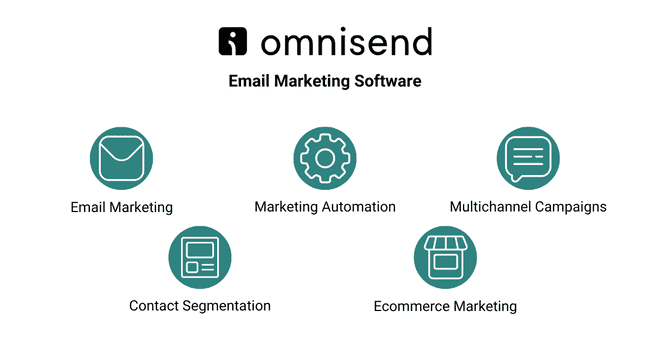
- Ecommerce Features: Omnisend connects directly to your web store. All the ecommerce data is right within Omnisend. You can pick products, generate promo codes for discounts, and show product recommendations.
- Drag and drop email editor: Omnisend’s editor packs all the tools for ecommerce. You can instantly add products from your store. It’s intuitive. Reusable blocks and AI writing help you quickly get emails out the door.
- Templates: Comes with 350+ professional quality email templates, mostly geared toward product promotions. You can set up templates with your own branding and reuse content blocks.
- Automation: Omnisend’s automation has conditions, actions, A/B testing, and workflow templates. This is great for targeting and driving conversions.
- Segmentation: You’ll get flexible and precise segmentation. It has a Customer Lifecycle Map and AI Segment Builder. Filters like Average Order Value and Total Spent are very helpful.
- SMS and push messaging: Omnisend also runs SMS and web push notifications. You can mix and match all in multichannel campaigns.
- Reporting and analytics: Omnisend has clear reporting on all campaigns and revenue attribution. We liked the reporting for cross-channel views, placed order rate, and revenue per message.
Get started with Omnisend for free
Omnisend Pros and Cons
Pros
- True ecommerce specialist: Adding products to campaigns, launching multichannel ecommerce automations, and segmenting customers based on purchase data make it easy to increase sales.
- Direct ecommerce platform integration: Omnisend connects with all major ecommerce platforms. Including Shopify, WooCommerce, BigCommerce and more. Syncing products, customers, and orders is quick and requires very little setup.
- Fast customer support: Help from Omnisend’s team is available 24/7 via live chat and email. They promise an average 4-minute response time. Responses were both fast and genuinely helpful in our tests.
- Great user reviews: Omnisend gets 4.7 stars in the Shopify App Store and 4.6 stars on G2. With 850+ customers rating it 5 stars.
- Sophisticated targeting: Flexible segmentation, behaviour tracking, and the Customer Lifecycle Map make it easy to target the right audience. Features like AI Segment Builder and ecommerce filters help you build precise segments.
- Excellent value for money: Omnisend prices start at $16/mo. It has a free plan with full functionality, which is perfect to start with.
Cons
- No checkout on landing pages: I’d like the option to build landing pages with add-to-cart buttons and checkout. You’ll have to use your ecommerce platform for shoppable landing pages.
- No multi-language interface: The Omnisend interface is in English only. So if you need a different language, this will be a tough one.
Is Omnisend for you?
Recommended if:
- You have an ecommerce store. Omnisend is 100% ecommerce focused and has great features for ecommerce senders. It’s not just set up to work smoothly with your online store. All the tools are geared towards driving sales for ecommerce senders. Some general-purpose platforms can be mixed.
- You are about to start your online store. Everybody has to start somewhere. With Omnisends free plan, you can start promoting your store at no cost. You get 24/7 live chat and email support even on the free plan. That’s very reassuring when you’re finding your feet with ecommerce email marketing.
- You want to drive more sales from email marketing. If you‘re not satisfied with the impact you’re getting from general-purpose email marketing platforms like Mailchimp, try Omnisend. Everything is there. From promotional drip campaigns, retargeting automations, and product recommendations. To detailed customer tracking and precise segmentation for targeting.
Not recommended if:
- You don’t have an ecommerce store. And no plans to launch one. Without the ecommerce integration, you lose a lot of what makes Omnisend stand out.
- You only want to send a simple newsletter. If you’d like to send newsletters to a smaller audience, there are cheaper and simpler tools.
Omnisend Review Rating Details
Ease of Use | Omnisend is very intuitive, even for beginners. The interface is clean with clear navigation. The drag-and-drop editor, pre-built workflows, and guided setup make it quick to start. |
Email Editor  | Omnisend’s email builder is intuitive. Premade layouts work well, and recent interface improvements make navigation smoother. It now includes better AI writing, dark mode preview, and universal layouts. And the best feature is dynamic product recommendations. |
Email templates | 350+ professional quality email templates ready for mobile. You can set up these templates with your own company branding in one go. Most are ecommerce promotion-focused, which makes sense. |
Email Types | Omnisend has newsletters, automated emails, auto-resend, and A/B testing. |
| Ecommerce Marketing Automation | The workflow builder makes building advanced automations simple. It has 37 prebuilt workflow templates. You can add conditions. The new features present trigger preview, automation alerts and overlap prevention. AI content generation inside flows makes it faster to launch a new automation. |
| SMS & Push Messaging | Add SMS to multi-channel workflows or send standalone SMS campaigns. You can personalize text messages. MMS is available for the US and Canada. We love that all paid plans include unlimited web push notifications. |
| List Management | Targeting is a real strength. Use the segment builder, behaviour tracking, sales data and tagging to make powerful. Customer lifecycle maps show the right customer engagement strategy per group. |
| Personalization | Omnisend does a good job with personalization, especially for ecommerce. You can use customer data like purchase history and browsing behaviour to personalize. Product recommendations and conditional content make it easy to send relevant ecommerce emails. |
| Landing Pages & Forms | We like the selection of form templates and the user-friendly form builder. You can build multi-step forms, use targeting rules, and protect forms with reCAPTCHA. Plus, Omnisend has gamified incentives like spin-the-wheel. And you can even generate forms from a prompt with the Forms AI Assistant. |
| Reporting & Analytics | Provides clear marketing metrics that you can drill into across email, SMS, and push. Includes sales attribution, product-level reporting, and customizable reporting. These make it easy to tie campaigns to revenue. |
Customer Service | Customers are raving about the responsive and knowledgeable customer service. 24/7 live chat and email support on all plans, including free. And we found this to be true in our own test. |
| Deliverability | Omnisend has solid deliverability features built in. It helps you set up proper domain authentication with guided steps. And checks your sender reputation over time. Tools like email verification keep your lists clean and reduce bounce rates. |
| Spam & Design Check | Omnisend has useful spam and design checks. You can preview how your emails will look across devices and inboxes, including dark mode. It also highlights potential deliverability issues, like authentication problems or poor list health. |
| AI Writing | AI writing tools are genuinely useful in day-to-day campaigns. You can generate subject lines, preheaders, and email copy. It can rewrite or improve text, suggest grammar fixes, and match your brand tone. In automations, the AI writes content based on the full workflow. |
| Integrations and API | 220+ integrations, including major ecommerce platforms, like Shopify, WooCommerce, BigCommerce, and Wix. Connecting your webshop is almost a one-click integration. |
| User Permissions | Omnisend has predefined roles like Owner, Admin, Manager, Editor, and Viewer. |
| GDPR & Legal Compliance | Omnisend supports GDPR compliance with features like double opt-in and consent tracking. You can store proof of consent and export contact data for access requests. |
| Interface Languages | Omnisend is available in English. |
| Customer Satisfaction | Omnisend has 4.6 stars on G2, 4.7 on Capterra, and 4.8 on the Shopify App Store. |
Overall Score
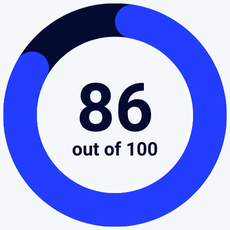
Omnisend gets the balance right between ease of use and powerful ecommerce features. You get automation, product recommendations, and multichannel campaigns, all built around your store data. It’s best for growing online stores, especially on Shopify. Add solid pricing and support, and it’s an easy one to recommend.
Getting Started with Omnisend
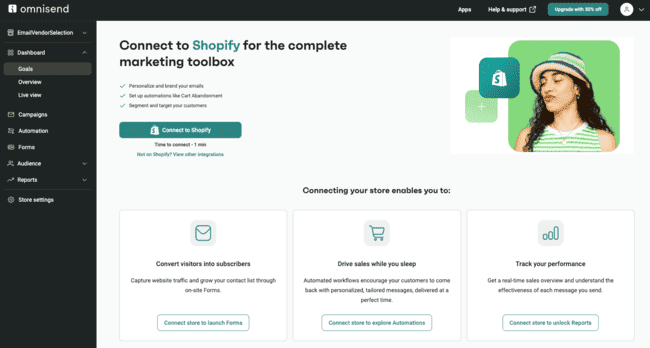
The best way to start using Omnisend is to directly connect your online store. First, sign up for a free trial with Omnisend. It will ask what ecommerce platform you use, and you’ll get the right wizard based on that. I chose Shopify and got going.
Clicking the “Connect to Shopify ” button on the dashboard takes me to the Shopify App Store. Here I just click on “Install”.
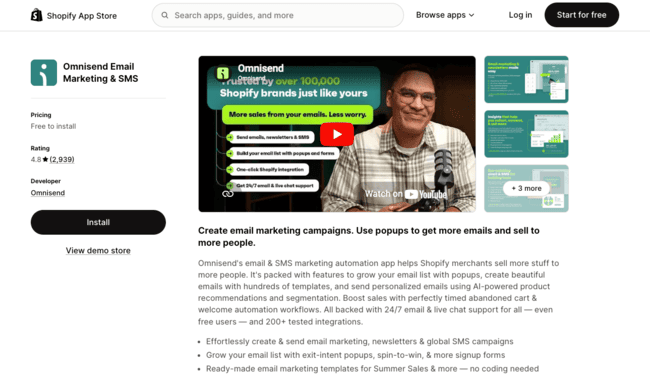
You’ll then see a permissions page explaining the data Shopify needs to share with Omnisend. After clicking Install again, you’ll be back in Omnisend with Shopify connected. It takes only about 1-2 minutes.
Get started with Omnisend for free
Migration
Say you’re moving from another email marketing platform, for example Klaviyo or Mailchimp. Some senders think migration is a bit daunting, but Omnisend they nailed the process. You can import contacts and customer data with minimal manual steps. The import process is even smoother for Klaviyo. Contacts get automatically tagged based on your existing lists and segments.
Setting up your sending domain is easier now, too. Omnisend has a verification flow with SPF merging. And guidance based on your DNS provider. There is clear feedback if something needs fixing. We all want to get authenticated fast and protect deliverability during migration.
Omnisend Review: Marketing Platform for Ecommerce
Email Templates in Omnisend
I want email marketing software to help me make great-looking emails. And the biggest shortcut to that is pre-made email templates. It’s like having a cheat code for graphic design.
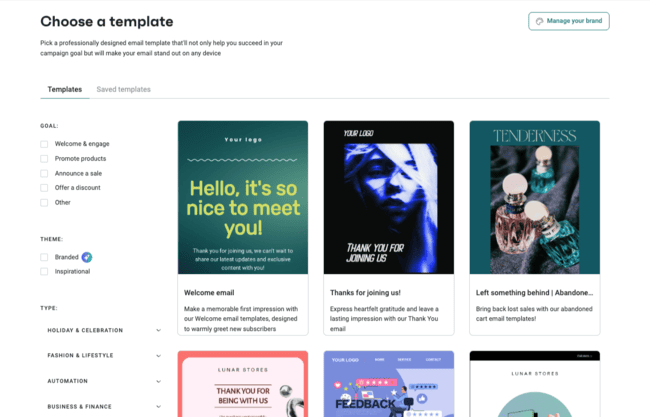
Omnisend has 350+ professional-quality templates to choose from. Not surprisingly, there’s a heavy slant towards product promotions and sales events. There could be a bit more variety. But overall, the amount of choice impressed me. I like that you can search by goal, such as promoting specific products or announcing a sales event.
I’m also a big fan of the branded templates feature. It pulls your company logo and brand colours from your website.
Creating and sending newsletters with Omnisend
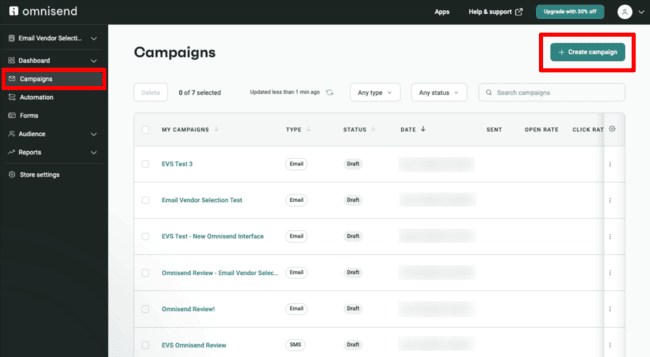
I had no problems learning how to create and send email campaigns in Omnisend. All the tools are easy to find. There are 4 options under Campaigns > Create Campaign. Email, Email A/B Test, SMS and Push Notification.
Clicking Create email takes me to the Email Settings page. This is an important step as it’s where you set the subject line for your campaign.
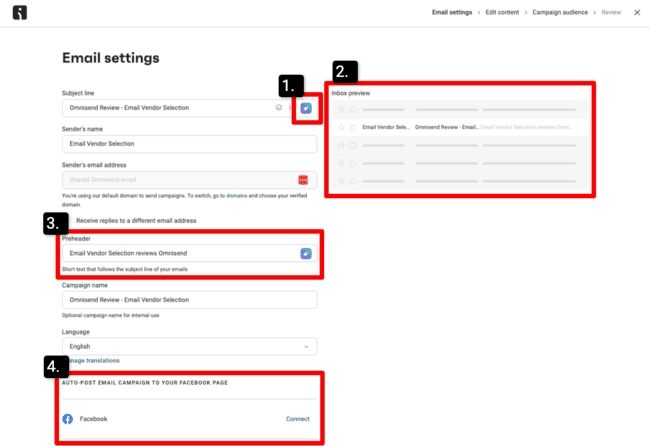
You can personalize the subject line with any information from a contact’s profile. Including product names and locations. There’s also an AI subject line generator (1) if you need inspiration. The AI subject line generator now has a cleaner look, prompt suggestions, and A/B testing support. It can also suggest a matching preheader.
A feature I really like is the Inbox Preview (2). This shows you both the subject line and the preheader as your contacts will see them. It’s a reminder that adding a preheader (3) is important, too. You can also auto-post your campaign to your Facebook account (4).
Next, I chose my template. I picked a branded newsletter template, so I already had my logo and colour scheme set.
Using the Omnisend Email Builder
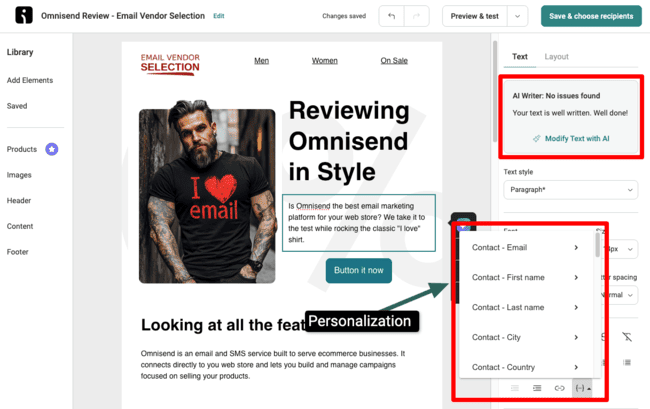
Your template opens in Omnisend’s drag-and-drop editor. I’ve used more than 30 no-code HTML email editors.
What I look for is ease of use and flexibility in 3 areas:
- Choice of elements
- Editing elements in the email
- And customizing the layout
I score Omnisend high in the first two. The editor is very intuitive. And my design only took around 5 minutes. That’s a sign of a good template and a user-friendly editor.
I like the way the editor works. The elements are in the Library on the left. Clicking on an element shows the editing tools on to the right. It keeps everything clear and easy to navigate.
Click on any element to open the editing options. The screenshot above shows the tools for text blocks. You can use the AI generator to write or refine text. Thanks to recent updates, Omnisend’s AI can better match your brand’s tone of voice based on your store content.
There are a lot of options beyond the standard “first name” personalization. You can add purchase details like order numbers, tracking URLs, and price. This is great for transactional emails, sale follow-ups and retargeting campaigns. And you can add your own custom fields for even more personalized messaging.
I love that Omnisend comes with built-in image editing tools. Not many email marketing platforms offer this. Another nice touch is that Omnisend pulls your saved colours into the colour picker. This makes it quick to keep everything consistent.
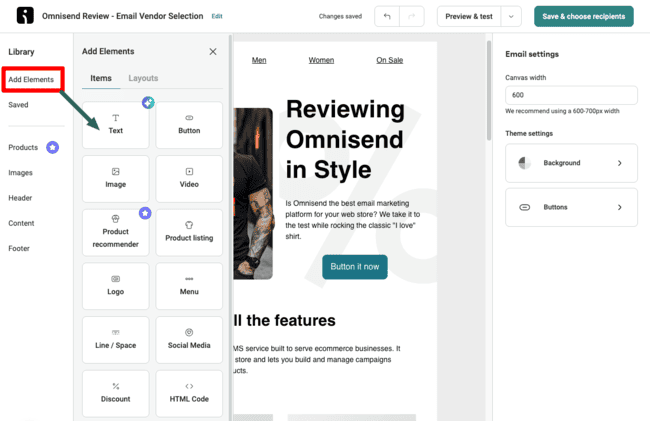
Onto adding elements to your design. The Add Elements section gives you all the individual elements. So things like text boxes, images, link buttons and product listings. Then the rest of the Library is pre-formatted ‘layouts’ or groups of elements. Product Listing blocks include product image, description, price and button.
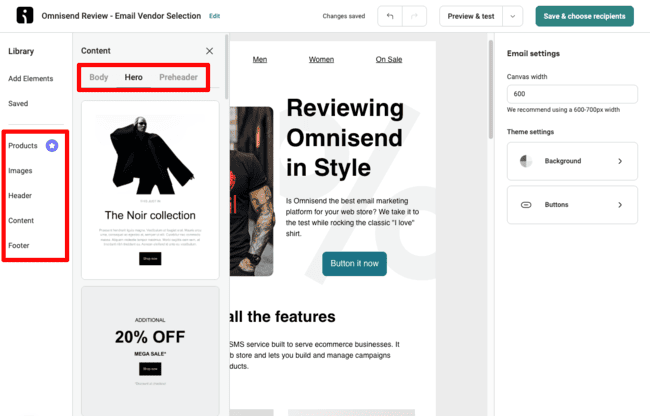
The pre-formatted layouts let you build a design quickly. For sections like header, body, and footer, there are multiple layouts per template. Which is really nice.
Omnisend has recently introduced Universal Layouts. These are reusable sections you edit once and they update across multiple emails. Headers, footers, and repeated promo sections are much easier to manage this way.
In our first review, we found the Library a little awkward to navigate, and it was covering parts of the email. Omnisend improved the way it groups content to make navigation easier. And the sidebar is slimmer to give you more room to work on emails.
Adding Product Listings from your Online Store to Emails
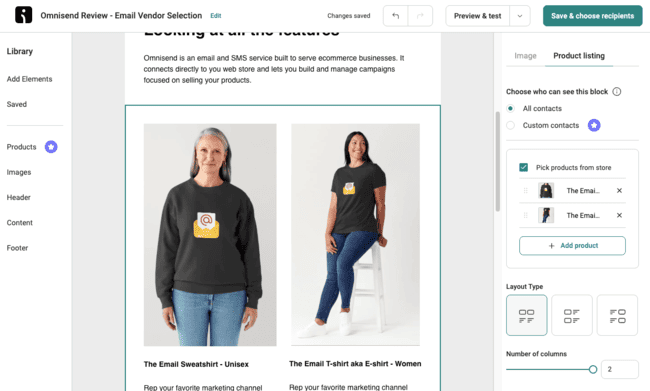
Omnisend’s email builder is packed full of product listings and promotional tools. In the screenshot above, I dragged and dropped a product listing layout into my email. You can add products by editing these placeholders manually. You can toggle what information to display. And add images, text, prices, and links to the buttons one by one.
But this all takes time. It’s much quicker to import product details from your connected web store. You do this with the Pick products from your store button.
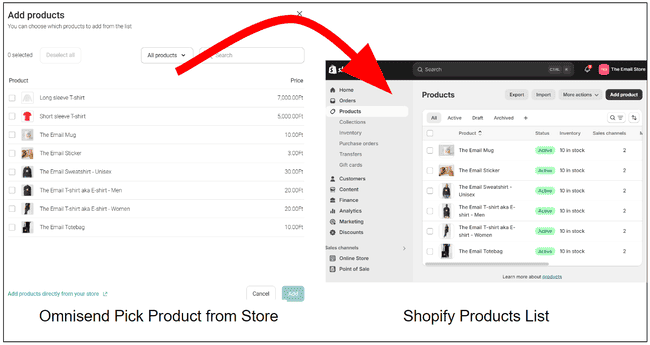
The button opens the product list from your connected store. You then choose the items you want to add to your email. Omnisend automatically imports all text and images. Plus a ‘buy now’ link to the product page on your web store.
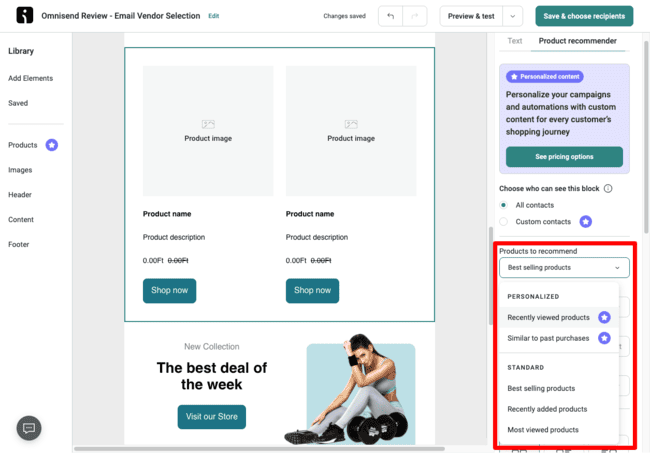
A cool alternative to a straightforward product listing is the Product Recommender (1). This imports products from your store based on set criteria (2). You can pick best-selling, recently added, products above a set price point, and most viewed products. Or include or exclude certain product categories and products.
The Discounts element (3) automatically generates discount codes for your store. You can choose cart discounts and free shipping. Cart discounts can apply to all orders, minimum order prices, or a collection. And you can set a percentage or a fixed amount.
Create your email campaign in Omnisend for free
Ecommerce Marketing Automation in Omnisend
Setting up Abandoned Cart Workflows in Omnisend
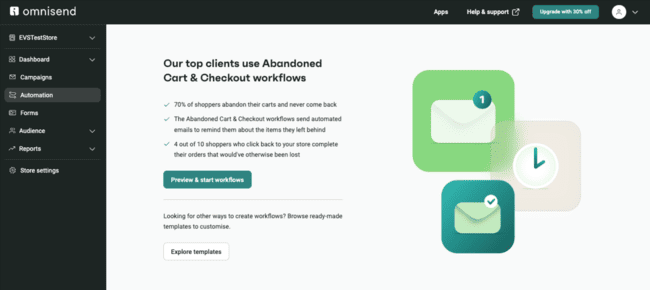
When you first click on the Automation tab, you’re encouraged to get started with an Abandoned Cart and Checkout workflow. Abandoned cart emails are one of the highest-converting emails of all.
I followed the link and was taken through a two-step activation. It’s incredibly simple. First, you can choose a discount to tempt customers back to purchase.
This adds the workflows to your active automations. One for an abandoned cart and one for an abandoned checkout. Now you can go in and tweak them. Choosing a premade template and editing it in the editor is quick and easy.
All the integration and personalisation are already there. So once you get started, this is really quick. Personally, it’s different from what I am used to. I like to see my workflows as I set them up, but it’s a nice shortcut.
Customizing Automations with Omnisend’s Workflow Editor
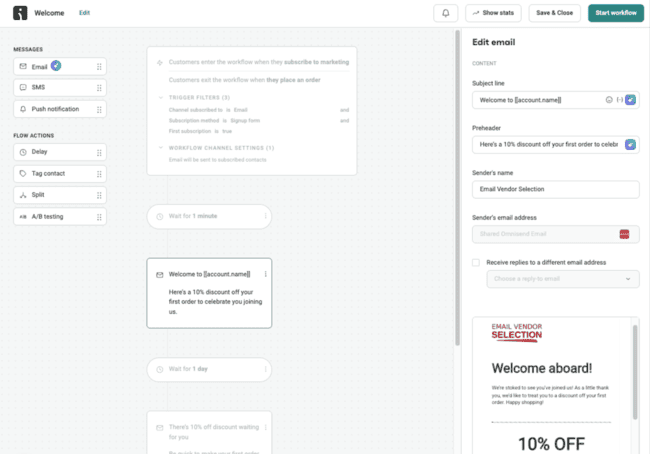
On the plus side, the editor is packed full of options. And it doesn’t have a long learning curve. Like the email editor, there’s a left-right split in what you can add to your workflows and editing actions.
You can send email, SMS, and push notifications with automations. And add actions, delays, and conditional rules. Delays can be set in minutes, hours, days, weeks, months, and specific time of day. This gives you a lot of control over how and when the workflow sends a message. You can also add tags to contacts to track progress through workflows. And add dynamic content to automation emails based on contact fields.
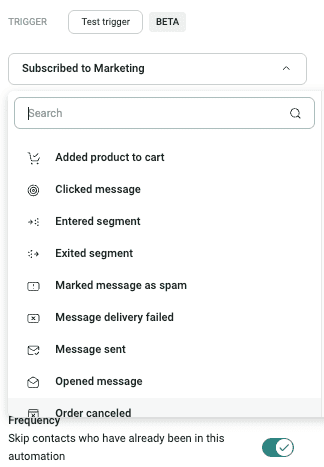
The editing options impressed me. For example, there are 20+ triggers you can choose to start a workflow. A lot of these are related to actions in your web store. So you can target contacts and customers based on their behaviour. And you can AB test in automations. Just add an “A/B testing” action to the automation, and choose the split between the two paths in percentage.
Omnisend recently added trigger previews to test workflow triggers and filters with contact data before you switch anything on. That is especially helpful to see or troubleshoot if contacts are entering a flow.
There are also thoughtful controls for keeping automations from clashing with each other. The frequency setting lets you skip contacts who are in a workflow or recently finished one. This is useful if you don’t want someone getting a post-purchase series and a cart recovery flow at the same time.
One final thing I love about Omnisend’s workflows is the pre-built branded messages. You can go off and build emails and SMS messages from scratch for each message. But you start off with a branded template for each one. This can save you so much time over all the automations you create. And Omnisend’s AI takes the whole workflow into account when suggesting content.
Omnisend has alerts inside the automation builder to flag logic issues, missing triggers, and other setup problems before launching a workflow. This saves time and reduces avoidable mistakes.
Omnisend’s Pre-Built Workflow Templates
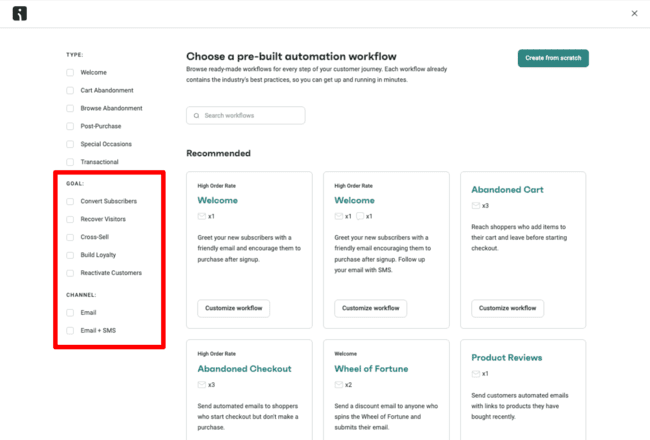
So what about other automations? Omnisend has 33 pre-built workflow templates, covering all common automations used in ecommerce. So things like welcome emails for new subscribers. Transactional emails. And workflows to increase customer loyalty.
I like the fact that Omnisend lets you filter workflows by goal, too. If you’re new to marketing automation, you might not know what browse abandonment is. But you know you want to recover visitors. Or get people to buy more with cross-selling.
The Customer Lifecycle Map
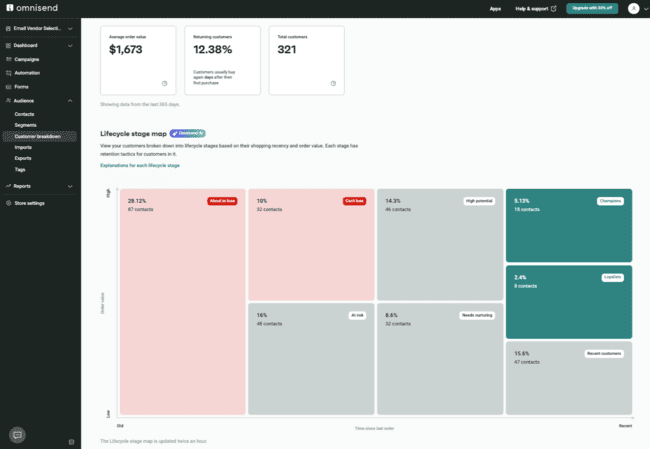
One outstanding feature that feeds into automation is Omnisend’s Customer Lifecycle Map. You can find it in the Audience tab (1) under Customer Breakdown (2).
It uses your web store data to map out engagement levels for all your customers (3). Now you can target customers you are at risk of losing. Those who need a little nurturing. And high-value loyalists and brand champions (4).
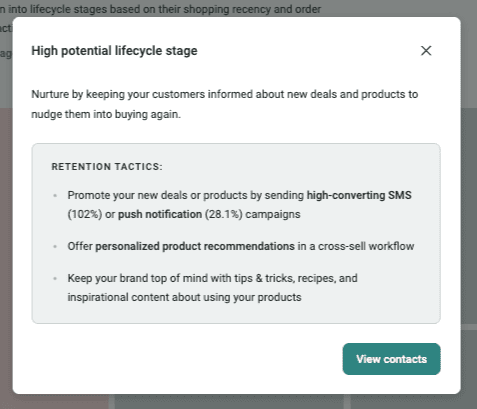
This is more than a visual guide of engagement. Each lifecycle stage comes with recommended Retention Tactics. Including the types of workflows you can build to target each group.
Get started with Omnisend for free
SMS Marketing Campaigns in Omnisend
As we’ve seen, Omnisend is an effective tool for Shopify text marketing, too. SMS marketing is an effective and direct way to reach mobile shoppers.
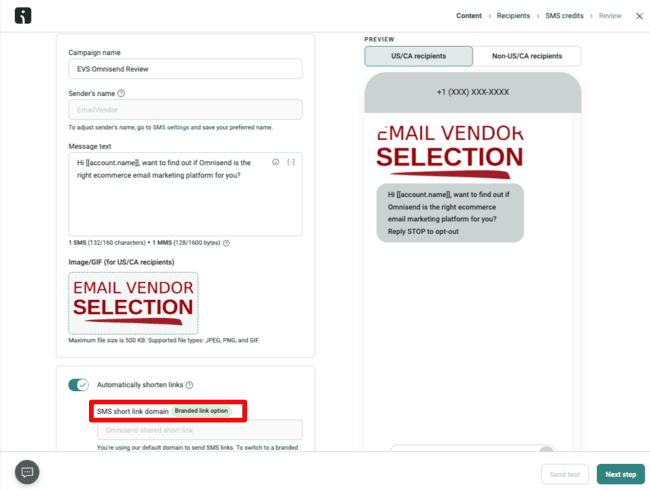
The setup process for SMS is a lot simpler than for emails. You can add an image if you are sending SMS in the US and Canada. You can create personalized messages using contact data. In automation workflows, you can also use the personalization tools to add links. For example, a link to an abandoned cart. Or to a product page you’re offering a discount on.
Beyond that, it’s simply a case of writing your message. You can add branded short links and use a toll-free number.
Subscribers can opt out by clicking an unsubscribe link. US and Canadian contacts can text:
- JOIN, SUBSCRIBE, or START to subscribe.
- UNSUBSCRIBE, CANCEL, QUIT, END, OPT OUT, OPTOUT, OPT-OUT, or STOP ALL to unsubscribe.
Omnisend uses credits for sending SMS messages. You’ll see recipient counts during SMS campaign setup, so it’s easy to see your cost before sending. See Omnisend Plans and Pricing for details.
Growing your list with Omnisend
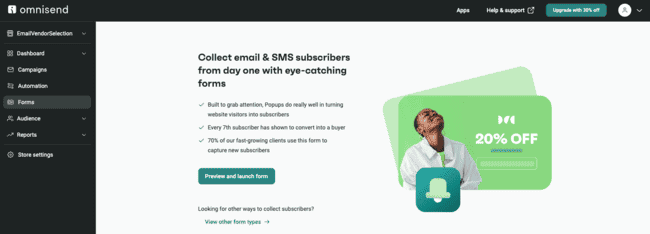
Omnisend’s lead capture features are in the Forms tab. Clicking Preview and launch form takes you straight into the form editor.
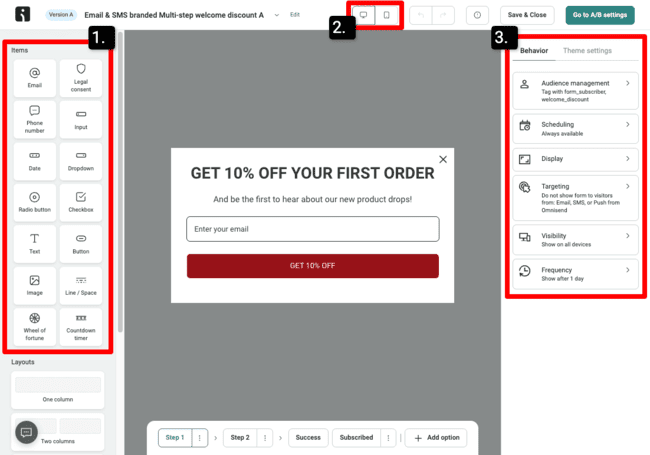
Omnisend’s form editor is very similar to the email builder. There are 14 items (1) you can add from the left-hand menu. You just drag and drop them into position. There are standard data capture fields like email and phone numbers. A preformatted legal consent element makes it easy to keep your forms GDPR-compliant. Then there are ecommerce-specific items.
Countdown timers are great for creating limited-time offers. And a wheel of fortune ‘gamifies’ lead capture with random prizes for signing up.
As you add items to your form, you can toggle between desktop and mobile views (2). This is important because you’ll get more sign-ups from mobile users these days.
The editing options impressed me. They’re listed as behaviors (3) to the left of the screen. Seven options give you so much control over what you can do with forms. They include scheduling forms to appear at set times or for limited periods. Setting rules for when a form appears, to who and how often. And you can A/B test different forms to see which performs the best.
Omnisend has added more targeting to forms. You can now target forms based on exact URL matches, partial URL rules, UTM parameters, traffic source, and visitor location.
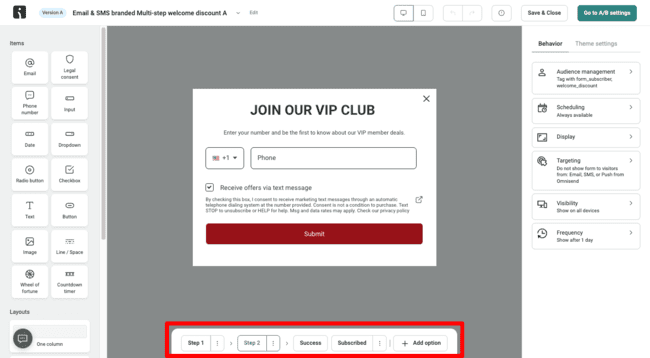
Another cool feature is the option to create multi-step forms. So as shown above, you can have one form offering a 10% discount if people sign up by email. And once they fill that, invite them to join your VIP club with their phone number. This is known to increase conversion and gives people a choice about what they want to share. And you end up with more data and opt-ins you can target in different ways.
You can set up thank you and already subscribed messages. I found this a really easy way to manage the whole sign-up process.
Recent improvements make the form builder better to use. Spacing, alignment, corner rounding, and text styling are more flexible now. The Forms AI Assistant generates forms from a simple prompt. Forms support Google reCAPTCHA to protect your list from fake and spam signups.
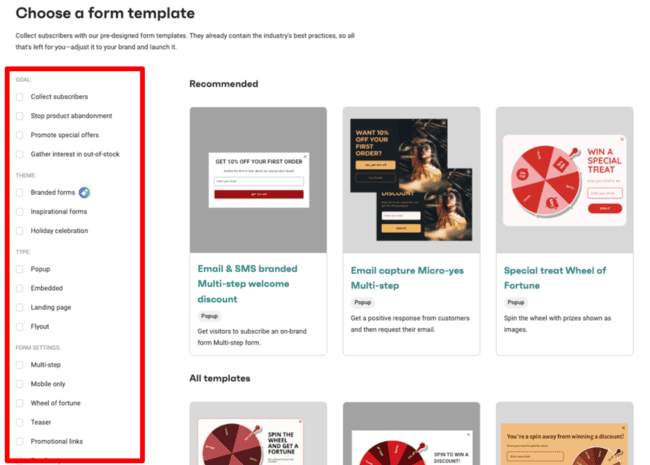
In the Form Library, I like that you can search form templates by goal. Apart from pop-up forms, you can choose from embedded, landing page and flyout templates. Flyouts usually appear on the side of a page and ‘fly’ off-screen once used. Alternatively, you can build a full landing page with a form. Omnisend only lets you build landing pages for lead capture. You can’t create campaign pages to direct people to.
You can also sort form templates by what Omnisend calls ‘form settings’. This includes multi-step form templates, forms with wheel of fortune, and mobile-only forms.
Managing contacts in Omnisend
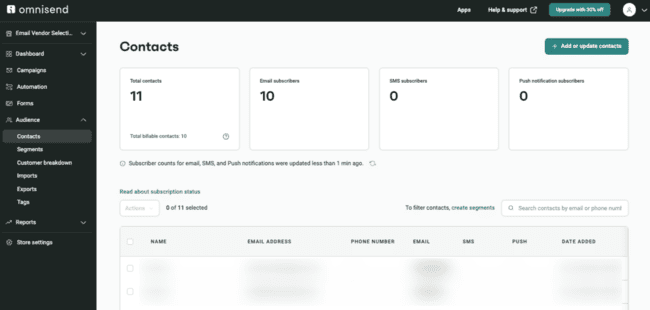
Omnisend’s contact management features are found under the Audience tab. Here you can view and add to your Contact list. All contacts in Omnisend get added to one master list. You then break down who you want to send a campaign to using Segments. You can also create and add Tags manually in the Audience tab.
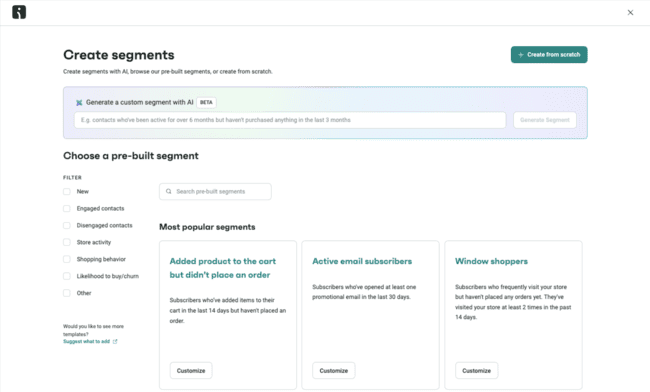
Segmentation in Omnisend is very simple. You have a segment builder. And segments update automatically, so the contacts are always up to date. Shopify segments sync directly into Omnisend, which is a big time saver.
The new AI Segment Builder generates segments for you, just tell it what you want. It will ask follow-up questions if needed. We liked it for building advanced segments.
There are 30+ pre-built segment templates, all are fully customizable. And you can copy any segment to quickly start a new one. They’re a great way to get started, especially if you’re setting it up for the first time.
Here’s what the Active email subscribers template looks like in the segment builder:
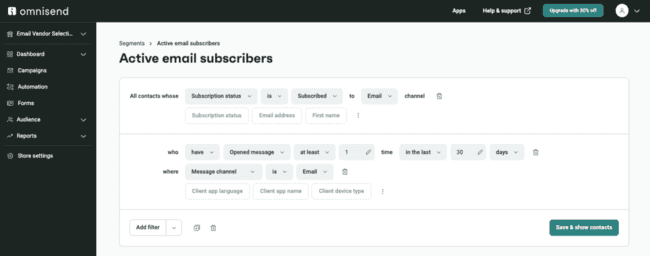
What impresses me about Omnisend’s segmentation is the flexibility and control you have. The example above has two data filters pre-set.
One for contact data.
The other for behaviour-tracking data.
And we have all the customer and purchase data from the ecommerce platform. Every grey drop-down and text box is a way to refine and customize.
You can add as many filters as you want, choose AND/OR conditions, nest them, and filter by tags.
Omnisend has also added a few nice quality-of-life improvements here. You can favorite segments to keep them at the top of the list. Average Order Value and Total Spent filters make it faster to build high-value segments. And Omnisend now shows the last detected location based on IP when available.
Minor point: Only once you save a segment will it show the number of contacts in it. That is already good, but I have found it very handy to see estimated counts while making segments.
Deliverability in Omnisend
Tools in the Deliverability tab check your sender domain and email addresses. These actively flag issues that could harm sender reputation and inbox deliverability.
You’ll find the email list hygiene tool in Reports > Deliverability. It checks your contacts for fake and inactive accounts to keep bounce rates low.
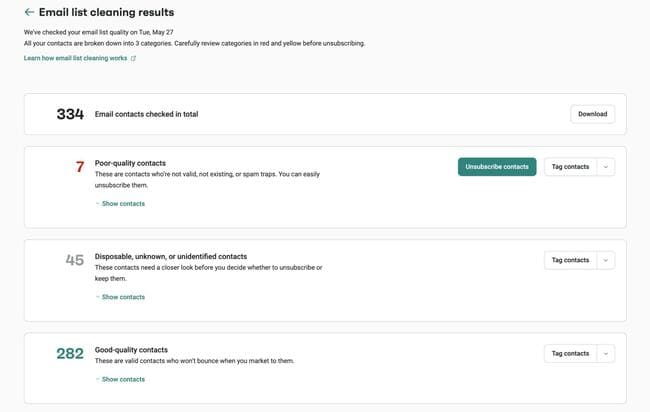
Omnisend gives you a label based on your email list hygiene: good, fair, or poor. If you decide to clean your list or a segment, just select it, and Omnisend will run the verification. When it’s over, you can automatically or manually unsubscribe poor-quality contacts.
Your sender domain and email address also get a good, fair, or poor label. If there are any issues, Omnisend will tell you the steps and help you resolve it.
Setting up domain authentication is easier thanks to the improved setup flow. This includes SPF merging and warnings for invalid or duplicate records. They also have instructions for different DNS providers. It’s the kind of behind-the-scenes improvement that matters.
The Omnisend team recommends increasing sending volumes over time for new customers. Omnisend doesn’t allow sending from email addresses with public domains like gmail.com, yahoo.com, or outlook.com. Both of these are good practices to make sure your emails will land in boxes. High-volume senders can also get a dedicated IP for sending.
Reporting and Analytics in Omnisend
You can quickly check sales performance in Dashboard > Overview. This includes revenue generated from Omnisend, total store revenue, and list growth.
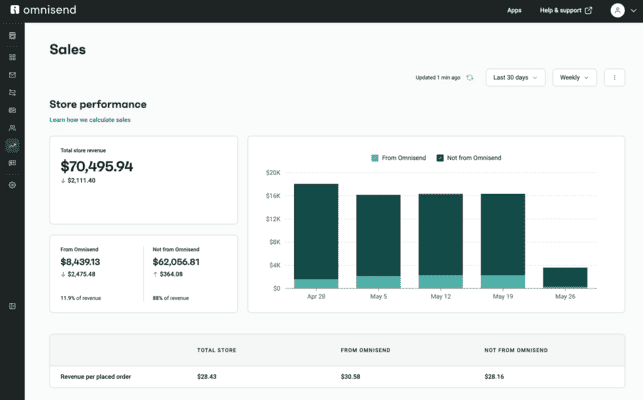
Omnisend’s analytics features are found in the Reports tab. Dashboards are split into campaigns, automation workflows, and sign-up forms.
Reporting had a noticeable refresh since our previous tests. Omnisend’s reports bring email, SMS, and push metrics closer in a more unified view. This makes cross-channel analysis easier. There are also new metrics like placed order rate and revenue per message. These show the direct impact on your bottom line.
Omnisend has all the analytics of the core metrics all email marketing platforms use. For emails, you can look up open, click, bounce, unsubscribe, and spam report rates.
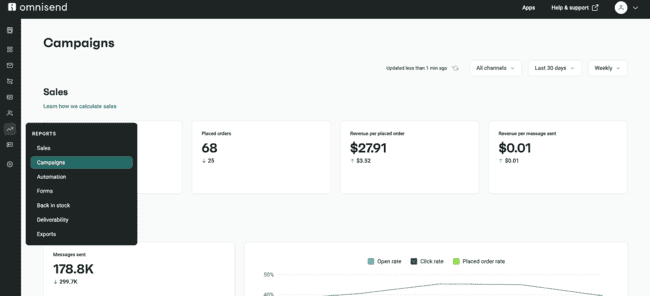
Like all the best platforms, Omnisend breaks these metrics down into finer detail. And makes it easy to access the figures you want to see. You can look at click rates per individual link in an email. Or open rates by email client or device. Or data for each step in a workflow. Or automation metrics between the dates you choose. You can check how much revenue each campaign and automation email generates.
In Live View, you can track real-time contact activity in your store. This includes: viewed products, viewed pages, viewed categories, added products to cart, started checkout, and placed orders.
The advanced reporting analyzes performance by segment. Graphs show trends over time and include conversion rates.
Where Omnisend analytics stand out is the reporting of sales and revenue data. It uses sales attribution to calculate revenue earned from marketing activity.
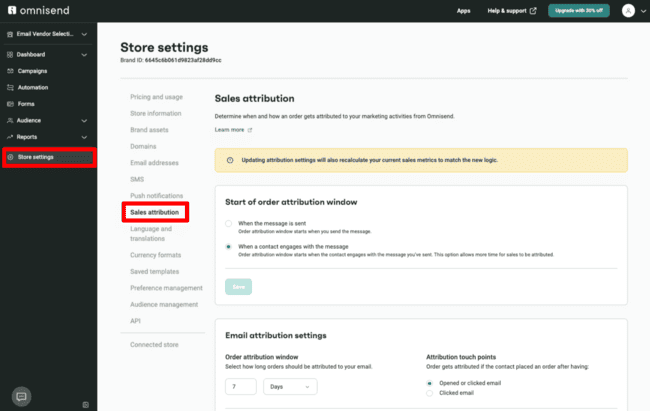
You can change how you calculate sales attribution in Store Settings > Sales Attribution. Here, you can set the ‘order attribution window’. Or, the timeframe for a sale to be attributed to a marketing interaction. And you can set up if the orders get attributed when a contact places an order after opening an email or clicking a link in an email. You can choose if attributed orders appear on the day the email was sent or on the day the order was placed.
Omnisend can automatically add UTM tags to your email links. The preset UTM campaign tags have the name and ID of your email. And will tell if the click comes from an automation or campaign email. This is clever, saving time while tracking the data you’re looking for, even if you send lots of email campaigns.
Get started with Omnisend for free
Omnisend Integrations and API
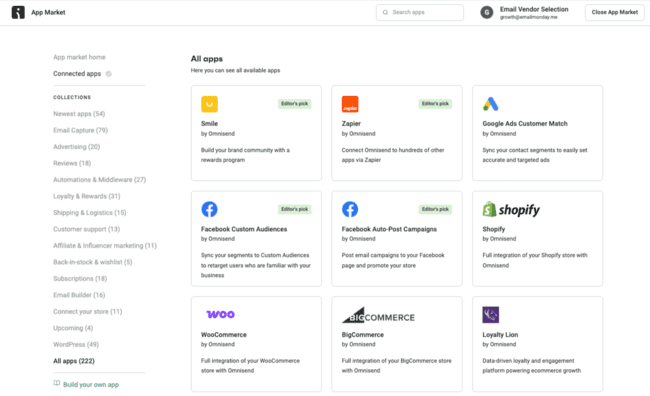
I’ve talked about how Omnisend is designed to work by connecting to your web store. It integrates with Shopify, WooCommerce, BigCommerce, Wix, and WordPress.
These ecommerce platforms are among 220+ integrations in the Omnisend App Store. You’ll find plenty of landing page builders, email editors, shipping apps, and Zapier. With the Google Ads integration, you can use the Google Customer Match feature. You can then share segments to use in Google Search, Gmail, Shopping, and YouTube ads.
Omnisend Plans and Pricing: How Much Does It Cost?
Omnisend pricing has 2 paid plans, Standard and Pro. The price is based on the number of contacts you have. There is also a free plan that includes 250 contacts, 500 emails, and 500 push notifications. The email verification service costs $0.20 per 100 contacts.
| Free | – 250 contacts – 500 email sends per month – 500 web push notifications – All Pro features |
| $16 Standard plan | – 500 contacts – 6,000 emails – Unlimited web push notifications – 24/7 support – All Standard features |
| $25 Standard plan | – 1,500 contacts – 18,000 emails – Unlimited web push notifications – 24/7 support – All Standard features |
| $59 Pro plan | – 2,500 contacts – Unlimited emails – Unlimited web push notifications – 24/7 support – Personalized product recommender – Advanced reporting |
| $90 Pro plan | – 5,000 contacts – Unlimited emails – Unlimited web push notifications – 24/7 support – Personalized product recommender – Advanced reporting |
The Standard plan starts at $16 per month for 500 contacts and 6,000 emails a month. You also get unlimited web push notifications.
The Pro plan starts at $59 per month for 2,500 contacts. Emails are unlimited. Compared to rival services, Omnisend is a great value. It has all the features ecommerce stores need for half the price.
SMS Marketing is an add-on for the Pro plan. It costs $7-$9 per 1,000 SMS to US recipients. Costs vary by country, and per-message rates decrease as you buy more credits. See Omnisend Pricing for details.
Omnisend Discount 💎
There’s a nice bonus here, too. We reached out to the Omnisend team and got an exclusive Omnisend coupon for our readers. Get started here and use the Omnisend coupon code EVS35 to get 35% off your first 3 months. This is the best deal available right now.
Omnisend Customer Support
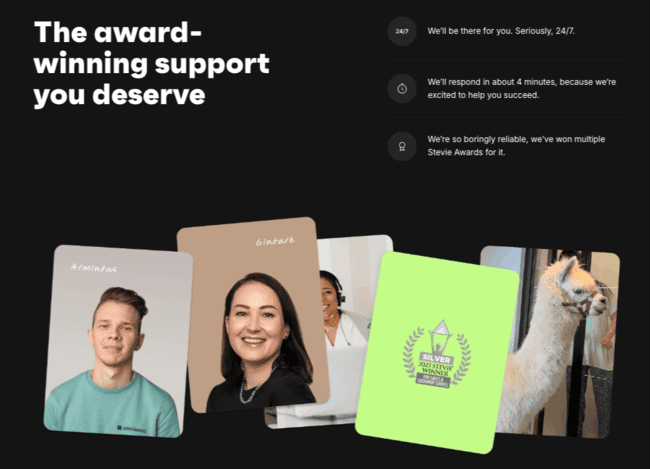
Omnisend’s customer support has 24/7 live chat and email support on all plans, including free. It’s pretty rare to find 24/7 live chat support on any email marketing software package. It says they have an average response time of just 4 minutes.
In our own support tests, we found this to be true. We got our first response in 2 minutes. We pushed them with quite a complex technical issue connecting multiple test shops. This was fully solved in 6 hours, very impressive.
Omnisend has 2620+ five-star reviews in the Shopify App Store.
The knowledge base has 610+ articles. A big chunk of these are dedicated to third-party integrations.
Is Omnisend the right email tool for you?
So that concludes my Omnisend review. Just one final big question to cover. Is it the right email marketing platform for you?
Omnisend impresses me with its feature set, ease of use, and value for money. It’s ideal if you run an ecommerce business with ambitions to grow. Its advanced targeting features and sales-focused automations will support your store. The free plan makes it a great option for starting and testing. I’d especially recommend it for Shopify users.
Get started with Omnisend for free
Omnisend Frequently Asked Questions (FAQ)
Is Omnisend any good?
Try Omnisend
What are the benefits of Omnisend?
Get started with Omnisend for free
Does Omnisend work with Shopify?
Where is Omnisend from?
Is Omnisend GDPR compliant?
Omnisend Alternatives
Omnisend vs. Mailchimp
Mailchimp is best known as a simple email marketing platform. While Mailchimp can send emails to promote a web store. It’s not focused on it and lacks functionality. Omnisend is specifically for ecommerce marketing.
Omnisend is also better value, especially as your business grows. Mailchimp pricing leaps from $20 a month on its Standard plan to $350 a month on its Pro plan. Omnisend starts at $16/month. For 5000 contacts, Omnisend Standard costs $81/month. While Mailchimp Standard costs $100/month. Check out our discount here to save more.
Omnisend has a detailed guide for stores looking to switch from to Omnisend. If you get a plan for $400/month or more, you’ll also get a dedicated customer success manager and migration support.
Check out the best Mailchimp alternatives here
Omnisend vs. Klaviyo
Omnisend and Klaviyo are both ecommerce email marketing services. The big difference is pricing. Omnisend is 35% cheaper. Klaviyo starts at $20 a month. You have to pay more for SMS (starting at $35 a month for 1,250 credits). For 100K contacts, Klaviyo costs $1380/month, and Omnisend costs only $900/month. With our exclusive discount, you get an extra 35% off. Get a free trial and discount here.
Feature-wise, both are similar. Especially for smaller brands. Klaviyo has a more user-friendly visual automation builder with more pre-built workflow templates. Omnisend is easier to use, more affordable, and has amazing support.
Read our full Klaviyo review or find the best email marketing tools for Shopify here
Omnisend vs. ActiveCampaign
The biggest difference between Omnisend and ActiveCampaign is their automation features. Omnisend’s automation options are very good. Its workflows are flexible and strongly focused on driving sales. Its Customer Lifecycle Mapping feature analyzes engagement. And uses that to recommend targeted workflows.
But ActiveCampaign is a real automation powerhouse. It offers 900+ pre-built marketing automation workflows. And it has a powerful visual workflow editor that offers incredible flexibility. Read our full ActiveCampaign review for more details about the automation builder. You can connect ActiveCampaign to Shopify and other ecommerce platforms. And it comes with a sales CRM. Omnisend is ideal for simple, straightforward ecommerce marketing. ActiveCampaign supports more sales and marketing processes for all business sizes.
Find out how much it costs in our ActiveCampaign pricing guide.
Omnisend vs. Maestra
Omnisend and Maestra are both ecommerce marketing platforms. They are servicing different types of ecommerce needs. Omnisend is for any online store, from small to growing to large. Maestra is not for smaller stores. It starts to be interesting for mid-market and larger DTC brands that need advanced retention marketing.
Omnisend is intuitive and affordable from the start. It starts at $16/month and has a free plan. With our exclusive Omnisend discount, you get 35% off your first 3 months. Check out our discount here to save more.
Maestra starts at $2,990/month for 150K active customers, with all platform features and unlimited emails included. Maestra has a built-in CDP, loyalty programs, advanced personalization, and WhatsApp. And a customer success manager who helps build and work on your campaigns.