











7 Best Affiliate Software for SaaS Companies 2026


The right affiliate management software is a big part of the success of your SaaS partner program.
We have experience working with all the mentioned affiliate services for over 10 years from the partner/publisher side. Now we’re also reviewing them from the partner management side.
Luckily, we also got some input from affiliate all-stars Nicole Pyzyk and Dustin Howes.
We started out with a list of 23 platforms and selected software we’d actually want to work in every day: dependable tracking, useful reporting, flexible commissions, strong partner management, and automation.
7 Best Affiliate Management Software Overview
Here’s how my picks for affiliate software compare:
| Best for | Free plan/trial | Starting price | Score | |
| FirstPromoter | Affordable SaaS affiliate tool | Yes, 14 days | $49/month |  |
| Trackdesk | Complex affiliate programs | Yes, 14 days | $299/month |  |
| Everflow | Performance marketing | No | Custom |  |
| Tapfiliate | Simple affiliate programs | Yes, 7-30 days | $74/month |  |
| Post Affiliate Pro | Highly custom programs | Yes, 30 days | $89/month | |
| Affise Reach | Global SaaS programs | Yes, 14 days | $500/month | |
| PartnerStack | Enterprise B2B SaaS programs | No | Custom | |
You need software that gives you great tracking, clean reporting, reliable payouts, and fraud checks.
In SaaS, managing partnerships can get complex. Free trials, recurring subscriptions, upgrades, downgrades, cancellations, and refunds all change what a partner is owed. And one flat commission rate won’t keep your best partners engaged.
This guide is for affiliate managers choosing software to run a program. If you are an affiliate or publisher yourself, see our guides:
How to Choose Affiliate Management Software
For SaaS companies, an affiliate program comes with unique challenges. You need affiliate management software that can keep up.
Recurring Commissions and Automated Payouts
Start with recurring commissions. SaaS subscription revenue changes when customers upgrade, downgrade, cancel, or receive refunds, and partner payouts need to change with it.
Check whether the platform recalculates commissions automatically or leaves you correcting payments manually. Also compare payout automation, invoicing, currency conversion, tax handling, and refund processing. These are the features that remove the most repetitive admin as your program grows.
“Keeping partners engaged long-term usually means more than a flat commission, different structures for different partner types, time-boxed challenges or contests, automated bonuses triggered by activity thresholds. That sounds like a nice-to-have until you actually try to run it.
If the platform can't natively support it, every one of those campaigns turns into manual reconciliation, tracking who hit what threshold by hand, adjusting commissions one by one.”

Reliable Affiliate Tracking and Attribution
Attribution errors flow straight through to reporting, fraud checks, and payouts. Look for platforms that combine several tracking methods rather than depending on cookies alone. Server-to-server postback tracking is particularly useful as browser privacy restrictions make cookie-based attribution less dependable.
Fraud Prevention and Dispute Management
Payout disputes are much easier to resolve when every conversion has a clear transaction history. Check whether you can search activity by affiliate and customer, inspect how credit was assigned, and manually override attribution when necessary. Fraud controls should also let you flag or block patterns such as self-referrals, suspicious IP addresses, unusual signup behaviour, and repeated coupon misuse.
Pricing and Total Cost
Affiliate software pricing can vary a lot as your program grows. Some platforms charge a flat monthly fee, while others increase the price based on affiliate revenue, transactions, active partners, or the number of campaigns you run. Check what happens when you move up a tier, and look for extra costs such as setup fees, payout fees, premium support, additional integrations, or access to advanced fraud and reporting tools.
Compare the total cost against the time the software saves and the size of the program you expect to manage in 12 to 24 months. You don’t want to migrate platforms just because your affiliate program outgrew the pricing model.
“The thing I always tell people: there's no universally best platform. It's fit for your size, your affiliate mix, and your budget. What matters for a startup with 12 affiliates is very different from what matters at 500 active partners with fraud as a daily reality.”

Partner Recruitment, Onboarding, and Performance
The recurring payment model makes long-term affiliate relationships important for SaaS brands. You want to choose the right partners from the start. Choose platforms with partner assessment tools and clear onboarding workflows. Look at how a platform helps you distribute campaign materials.
Reporting, Segmentation, and ROI Tracking
As a program manager, you always want to demonstrate value. Strong reporting makes a big difference. You need easy access to affiliate, transaction, and commission data to assess program ROI, verify customer retention, and find areas for growth. Good reporting should also let you segment partners by behaviour. Look for filters based on activity, signup date, conversion rate, revenue, and partner type.
“Fraud detection, that's the one that actually protects the business. I want a system where, if I hand it rules (self-referrals, suspicious IP addresses, unusual signup patterns), it flags that automatically. I don't want to be making fraud calls off gut feel or hours of manual digging.
Right behind that is reporting. It's impossible to make good decisions when you're in the dark about what's happening in your program, and I list it second only because good reporting is often what lets you catch a fraud or integration problem in the first place. Reporting has to be granular, filterable by group and by individual partner, and comparable across time periods. It also has to be genuinely segmentable, not just via tags. I want to build segments by drop or gain in activity, by signup date, by conversion rate, by revenue, without constantly reshuffling my groups just to look at a different slice of my base.
The third piece, and this is increasingly non-negotiable in 2026, are integrations and APIs. A platform can have great fraud tools and great reporting natively and still box you in if it can't talk to the rest of your stack. I want it to connect to CRMs, email tools, Slack, and increasingly AI tools directly, through something like Claude's MCP (Model Context Protocol), so an AI assistant can pull live program data or trigger actions instead of me manually exporting a CSV every time I want to ask a question about my own data.”
Affiliate Software vs Network vs Agency
There are different ways to run an affiliate program. But what are the differences?
- Affiliate software gives you the tools to run your own program. That includes tracking referrals and attributions, applying commission rules, and making payments. You take charge of recruiting partners. But many platforms help you out with partner matching and onboarding tools. Partner-facing portals let you communicate, share links and campaign materials.
- Affiliate networks serve as middlemen between businesses and publishers, influencers and other partners. They operate as a marketplace where prospective affiliate partners can find one another. But they control key parts of the process like tracking and payments.
- Marketing agencies run fully outsourced affiliate programs. They provide access to specialists in running successful affiliate campaigns. That includes finding, vetting, and onboarding potential partners. Agencies can take full control of offers, commission terms, campaign management, and creative.
The biggest difference is how much of the program you want to own yourself. Affiliate software gives you the most control, but someone on your team still has to recruit partners, manage campaigns, monitor attribution, and handle relationships. A network makes partner discovery easier and takes over parts of tracking and payments, but you work within its system and fee structure. An agency removes much more of the day-to-day workload, at a higher cost.
For a SaaS company, software usually makes sense when you already have the internal resources to run the program. A network becomes more attractive when access to established partners is the main challenge. An agency is the better fit when you want the channel but don’t have the expertise or capacity to operate it internally.
7 Best Affiliate Software Platforms
FirstPromoter

FirstPromoter is an affiliate and partner management platform for SaaS businesses. You can use it to run affiliate, customer referral, influencer, and B2B partner programs. It’s especially strong at handling recurring commissions.
FirstPromoter’s best features
- Tracks recurring commissions with flexible attribution windows.
- Native billing integrations via Stripe, Paddle, Chargebee, Recurly, and Braintree. Plus API available for more billing providers.
- Flexible rewards and commission rules for affiliate, referral, influencer, and B2B partner programs.
- Built-in fraud checks for self-referrals, suspicious IP matches, paid-ad traffic, refunds, and chargebacks.
- Detailed performance reports per partner, link, source and campaign
- Customizable affiliate portal, with custom domains on Business and higher plans.
FirstPromoter can serve every business from solopreneurs to enterprise clients. But its biggest customer segment is B2B companies with 50-200 employees.
Recurring subscriptions, partner programs, and payouts live in the same system. For growing SaaS companies, which is a big advantage. You can run affiliate, referral, influencer, and B2B partner programs without moving to an enterprise-priced PRM.
Managing recurring commissions gets tricky when subscribers upgrade, cancel, or ask for a refund. FirstPromoter tracks subscription changes and adjusts payouts automatically. It does this via integrations with payment platforms like Stripe, Paddle, Chargebee, and Recurly.
It manages payouts for different partner programs in single payment runs for convenience. If you qualify, FirstPromoter can pay affiliates on your behalf.

FirstPromoter allows you to give partners several ways to promote:
- Automatically share affiliate links. It’s just a referral code added behind your own site URLs.
- It can generate unique coupon codes.
- Create landing pages unique to a specific partner and share the URLs.
You give partners multiple ways to promote your brand. It’s easier for a podcaster or TikTok influencer to read out a coupon code than to share a link. Referral links also have customizable cookie windows.
FirstPromoter reports on revenue, conversion rates, traffic, upgrades, and free-to-paid trial conversions by partner. Then it maps these against SaaS-specific metrics, like churn rates, upgrades, and free trial conversions. So you can identify the most valuable partners and partners who generate lots of leads but few long-term customers.
FirstPromoter also has built-in fraud checks. It flags self-referrals based on matching email addresses or IPs and identifies referrals coming from paid ads. You can allow, hold for review, or block paid-ad commissions by campaign or individual partner. It also lets you set manual approval thresholds and automatically reverses commissions when it tracks a refund or chargeback.
FirstPromoter Pros
- Automatically adjusts recurring commissions as subscriptions change.
- Runs affiliate, referral, influencer and B2B partner programs from one account.
- Fraud controls help catch self-referrals and hold or block questionable commissions before payout.
- Connects easily with common SaaS billing platforms including Stripe, Chargebee, Paddle and Recurly.
- Strong performance tracking covering revenue, traffic, conversion, and churn rates.
- Cheaper than many rival partner management platforms.
FirstPromoter Cons
- It doesn’t have a native partner marketplace for finding affiliates.
- The Starter plan has a $5000/mo revenue cap, which you will hopefully hit very quickly.
FirstPromoter pricing starts at $49 per month. The Starter plan has a $5,000 per month revenue cap and 3 campaigns. You can try it for free for 14 days and get 2 months free by paying annually.
Partner-side insight: We know FirstPromoter from the programs managed by Mailtrap, Stripo, Mailmodo, SurferSEO, Visme, TextMagic, and many more. The dashboard is simple to sign up for and quick to see the stats. Tracking is consistent, and the platform has hardly any problems. And linking to any page with just a partner ID behind a URL is extremely convenient.
Verdict: FirstPromoter is my top pick for small and growing SaaS companies. It’s affordable, handles recurring commissions well, and lets you manage different types of partner programs.
Trackdesk

Trackdesk specializes in managing and scaling large affiliate programs. It stands out for programs that involve lots of partners, different rewards, and commission structures. Its main customer base is mid-market DTC, SaaS, fintech, and ecommerce businesses. Marketing agencies can use it to manage affiliate programs for multiple clients.
Trackdesk’s best features
- Flexible commission models, including CPA, CPL, CPS, RevShare, tiered, and MLM.
- Affiliate marketplace with 100,000+ vetted partners.
- Real-time tracking with S2S, pixel, coupon, and deep-link attribution.
- Custom dashboards and real-time reporting.
- Built-in fraud detection and bulk payouts.
Trackdesk’s marketplace gives you access to more than 100,000 vetted creators, publishers, and influencers. You set your program terms and target locations, and Trackdesk matches the offer with relevant partners.
As your partner base grows, commission management gets more complicated. Trackdesk gives you considerably more control over commissions than a basic affiliate platform. You can combine fixed fees, percentages, revenue sharing, progressive tiers, and bonuses. Then vary the rates by partner or offer.
That flexibility only works if attribution is reliable. Trackdesk supports server-to-server postbacks, pixel tracking, coupons, and deep links, with event-level reporting for clicks and conversions. It gives you full visibility with detailed reporting dashboards. These let you track and analyze individual events like clicks and conversions. You can build your own custom reports with a drag-and-drop editor.
Larger programs also create more opportunities for fraud. Trackdesk monitors clicks, conversions, and affiliate activity for suspicious patterns. You can set your own fraud rules and investigate anything it flags.
Trackdesk supports automated affiliate payouts through Stripe Connect and Tipalti. You can also prepare bulk payment files for other payment methods, like PayPal.
Trackdesk Pros
- Supports large, complex affiliate networks.
- Large marketplace of vetted affiliates helps you grow quickly.
- Flexible commission structures and several ways to automate and manage bulk payouts.
- Advanced tracking and real-time fraud alerts
- Detailed event-level analytics and custom reporting
Trackdesk Cons
- Start pricing puts it out of reach of small affiliates.
- Its cheapest tier caps the number of active offers and coupons you can use.
Trackdesk pricing starts at $299 a month. This includes 5 user seats, 10 active offers, and 100 coupons. You can test it out on a 14-day free trial.
Partner-side insights: We know Trackdesk from the programs managed by SlickText, MailerLite, and more. The tracking works well. Linking to any page with just a partner ID behind a URL is extremely convenient. The statistics dashboard is sometimes hard to get clear, with no difference between new conversions and recurring payments.
Verdict: Trackdesk is best suited to mid-market businesses and agencies looking to manage and grow large affiliate programs.
Everflow

Everflow is an all-in-one partner marketing platform. It lets teams run affiliate and referral programs alongside advertising and media buying. That makes it popular with performance marketers who want to manage all third-party partnerships in one place.
Everflow’s best features
- Multichannel tracking.
- Detailed click-to-conversion analysis and attribution.
- Rule-based fraud detection and traffic monitoring.
- White-label landing pages, portals, and custom domains.
- Native payment processing and automated invoice generation.
Everflow goes beyond tracking affiliate links. It can attribute inbound traffic from referral codes, coupons, ads, QR codes, mobile apps, and organic sources in the same system.
From there, Everflow tracks conversions and attributes them back to the source. That’s the foundation for managing affiliate programs, media buying, and strategic partnerships. You get a lot of freedom in choosing commission models and customizing rewards. Everflow’s native Pay tool automates all payments and invoicing. Detailed performance tracking helps you understand exactly what you are paying for. For example, Everflow’s analytics will quickly distinguish affiliates who generate repeat customers from those who just generate a lot of traffic. Traffic rules and fraud controls further help you block poor-quality sources before they waste budget.
Everflow has an affiliate marketplace to help you find new partners. You can search by vertical and promotion type to find influencers, media buyers, and affiliate networks to fit your niche. I really like Everflow’s agency partner program. This helps you find performance marketers if you want to outsource.
Everflow Pros
- Single platform for performance and partner marketing.
- Outstanding conversion and performance tracking across channels.
- Simplifies payments and invoicing with its own integrated payment gateway.
- AI fraud and link-misuse monitoring.
- Real-time reporting even at very high traffic volumes.
Everflow Cons
- Pricing is quote-based, and Everflow requires a 6-month commitment.
- Everflow isn’t a plug-and-play platform. Its tracking systems require technical setup.
Everflow doesn’t publish its prices. You have to book a demo and request a quote, and they require a 6-month commitment.
Verdict: Everflow is best for mid-market businesses and agencies looking to optimize performance marketing across multiple channels.
Tapfiliate
Tapfiliate is a simple affiliate management platform aimed at small businesses and start-ups. It gives online retailers, dropshippers, SaaS companies, and course creators an affordable alternative to affiliate networks.
Tapfiliate’s best features
- Flexible commissions with multiple calculation types and rewards.
- Real-time tracking and reporting.
- Customizable affiliate portal.
- Automated workflows for recruiting existing customers as affiliates.
- 30+ integrations for ecommerce and payment tools.
Tapfiliate makes affiliate and partner management accessible. You can recruit and approve affiliates, create referral links and coupons, calculate commissions, manage payouts, and track performance. But setup and management is less daunting than enterprise PRMs. And it’s much more affordable.
Some budget affiliate marketing software has very rigid commission structures. With Tapfiliate, you can choose between fixed, percentage-based, recurring, and lifetime payouts. Lifetime commissions are like recurring payouts but for non-subscription-based purchases. If a customer buys something from an affiliate link, the affiliate gets a cut of all future purchases.
You can adjust rates for different partners, products, or campaigns. And you can add conditions for earning extra rewards and bonuses. For SaaS companies, Tapfiliate can track recurring subscription commissions. Stripe supports this directly. Chargebee requires Zapier or webhooks for recurring commissions, while Recurly requires Zapier.
Tapfiliate can also help you turn existing customers into affiliates. For a smaller SaaS, that can be useful to recruit partners who already know the product. Tapfiliate supports automated customer-recruitment workflows with selected integrations, including Stripe, WooCommerce, Shopify, Memberful, and Moonclerk. You can use these to invite customers to join your affiliate program after a purchase or through automated follow-up emails. You can add referral invitations to thank you pages after checkout. Or create automated email sequences that target your most loyal customers.
Tapfiliate has basic fraud controls. It flags potential self-referrals when an affiliate’s IP matches the conversion and prevents duplicate conversions using identifiers such as customer and transaction IDs. You can also blacklist suspicious IP addresses and domains with help from Tapfiliate support. For deeper checks on bot traffic, unusual click patterns, and suspicious locations, you need to analyze raw click data yourself through the API.
Tapfiliate Pros
- Easy to set up and intuitive to use.
- Flexible recurring, lifetime, and performance-based commissions.
- Helps you recruit existing customers as affiliates.
- More affordable than enterprise PRMs and affiliate networks.
- Real-time performance tracking and reporting.
Tapfiliate Cons
- Automated payouts rely on Trolley on the Scale plan or custom API automation. Tapfiliate’s own hands-free payout service is in the works, but not here yet.
- Advanced features like affiliate groups, bonus commissions, item-based commissions, and custom domains require the Scale plan.
Prices start at $74 a month for one affiliate program. This plan includes 50 affiliates, 5,000 clicks per month, and 500 conversions per month. Tapfiliate offers free trials from 7 to 30 days depending on what tier you sign up for.
Verdict: Tapfiliate is best for small online businesses looking to run simple affiliate and customer-referral programs.
Post Affiliate Pro
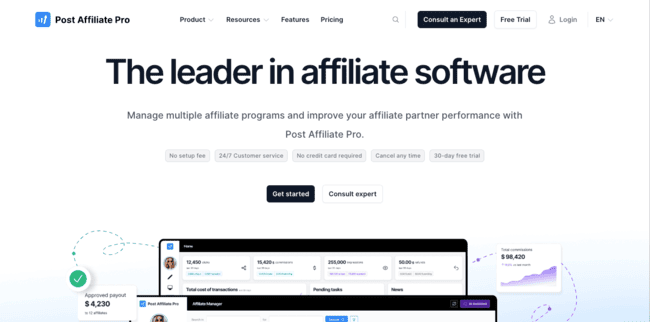
Post Affiliate Pro is an affiliate software founded in 2004. It covers tracking, commissions, affiliate management, payouts, reporting, and fraud protection. And helps businesses create their own affiliate networks.
Post Affiliate Pro’s best features
- Flexible commission structures, including recurring, split, and multi-tier rewards.
- Multiple attribution methods, including cookies, S2S, pixels, and IP tracking.
- Automation tools for campaigns, payouts, and performance tracking.
- Affiliate network tools for running multiple programs.
- 220+ integrations with ecommerce, payment, and CRM platforms.
Post Affiliate Pro lets you tie commissions to anything you like: page visits, form completions, event registrations, purchases, or demo bookings. As you can define custom actions as triggers for rewards.
It has commission structures designed for working with networks of affiliates at once. Multi-tiered commissions let partners recruit and manage other affiliates, but give you final oversight. Split commissions let you reward several affiliates when more than one contributes to a sale.
Another strength is how many tracking methods Post Affiliate Pro uses for attribution. It supports first-party cookies, HTML5 storage, IP referrals, server-to-server, and pixel tracking.
Post Affiliate Pro’s Network plan lets agencies run several affiliate programs from one account. You can have multiple merchant accounts. Each merchant can manage their own campaigns, commission rules, tracking, and promotional materials.
Post Affiliate Pro Pros
- Custom actions let you link rewards to any event.
- Great value for advanced affiliate management features.
- Multiple tracking methods help protect against lost attribution.
- Suitable for managing several programs, including agency-level management.
Post Affiliate Pro Cons
- Recurring commissions require the $269/month Ultimate plan.
- The interface is starting to feel a little dated.
Post Affiliate Pro starts at $89 a month for 10,000 tracking requests. SaaS companies that need recurring commissions will need the Ultimate plan, which costs $269 a month. There are no limits on affiliates, and you can test it with a 30-day free trial.
Verdict: Post Affiliate Pro is my top pick if you want complete freedom to build a bespoke affiliate program.
Affise

Affise is a large-scale performance and partner marketing platform. It’s popular with enterprise brands, marketing agencies, media buyers, ad networks, and mobile developers. There are separate products for different audiences. Affise Performance is an affiliate marketing platform for networks and agencies. Affise Reach is a specialist affiliate service for SaaS brands.
Affise’s best features
- Partner marketplace and recruitment tools.
- S2S, pixel, and probabilistic attribution.
- Automated global partner payments.
- Custom reporting tools.
You can use Affise Reach for affiliate programs, influencer marketing, and customer referrals. Instead of outsourcing to a network or agency, you keep full control over recruitment, tracking, and partner payments.
For partner recruitment, the Affise Reach marketplace connects to existing affiliate networks. You can narrow potential partners by country, traffic source, vertical, audience size, operating system, and other criteria before reaching out. Every publisher listing shows detailed information about their audiences and traffic sources.
Affise supports advanced tracking methods like server-to-server (S2S) postbacks and pixel tracking. But its most unique feature is probabilistic attribution. Affise developed this in response to Apple’s privacy policies blocking the use of unique personal identifiers. Probabilistic attribution relies on statistical modelling of universally available metadata instead. Attribution can still happen even when strict privacy controls are in place. And it works across any platform without data integrations.
Affise handles payments for international affiliate programs. With Reach, you pay one monthly commission invoice to Affise. And it automatically pays your partners for you. It supports more than 60 currencies across 214 countries.
Affise Pros
- Dedicated affiliate marketing product for SaaS brands.
- Marketplace helps you recruit publishers, agencies, and networks.
- Multiple tracking methods, including S2S and probabilistic attribution.
- Automates partner payouts in 60+ currencies.
Affise Cons
- More complex than self-service affiliate management tools aimed at smaller SaaS teams.
Verdict: Affise is best for larger SaaS brands looking to build and manage international affiliate programs.
PartnerStack

PartnerStack is an enterprise partner relationship management (PRM) platform. Its core customers are B2B SaaS and tech companies. As a program manager, it gives you a single platform for finding, recruiting, and managing partners.
PartnerStack’s best features
- B2B SaaS partner marketplace.
- Affiliate, referral, reseller, and co-sell program management.
- Partner onboarding, training, and certification.
- Lead and deal registration with CRM syncing.
- Flexible commissions and consolidated partner payouts.
- Fraud detection using transaction, device, IP, location, and behavioral data.
Most PRMs focus on managing partners you already have. PartnerStack also helps you find them. Its marketplace has over 130,000 active B2B partners, and you can list your program there or use its AI matching tools to identify potential fits.
PartnerStack also includes an LMS for building partner courses and certifications on the Growth plan and above. This is useful when affiliates, resellers, or co-sellers need to understand a complex product before they can promote it effectively.
Long sales cycles pose challenges for SaaS partner programs. PartnerStack gives you more control over what happens between referral and sale. You’re not limited to paying commissions for completed sales. You can also reward sign-ups and clicks. It uses shared pipelines to help you track activity with your partners.
For example, you can connect affiliate links to a pipeline. When a new lead clicks the link, it creates a new deal. You can add any stages you like and set rewards at different stages to incentivize partners. Everyone gets full visibility throughout the sales process. And you can add different ways for partners to earn.
PartnerStack uses Sift for fraud detection. It monitors partner sign-ups, transactions, IP addresses, device fingerprints, location data, and behaviour across the PartnerStack network. PartnerStack flags suspicious partners and automatically holds their commissions while you investigate. You can approve the partner as trustworthy or remove them from your program. One limitation is that PartnerStack controls the fraud logic, so you can’t create your own fraud rules.
PartnerStack Pros
- Complete ecosystem for B2B SaaS affiliate, referral, reseller and co-sell programs.
- Large marketplace for finding new affiliate and channel partners.
- Automatically screens partners and transactions for fraud and holds suspicious commissions for review.
- Partner onboarding and training tools.
- Tracks partner-sourced leads and deals through longer B2B sales cycles.
- Supports complex commission structures with multiple incentives and flexible rewards.
PartnerStack Cons
- Lower plans make you choose between affiliate link tracking and lead/deal registration. You need Enterprise to use all of them together.
- PartnerStack charges an annual subscription plus a percentage of partner commissions.
Partner-side insight: We know PartnerStack from programs managed by Brevo, SMTP.com, Bouncer, Thinkific, and many more. As a premium partner, the interface is great and the number of programs there is huge. The stats are insightful, and tracking is consistent. There used to be some stats misaligned in the past, but that is fixed now.
And the platform has hardly any problems.
Verdict: PartnerStack is best for large B2B SaaS companies looking to build multi-partner programs. It lets you run affiliate, referral, resale, and co-sale partnerships in one place. Its marketplace and onboarding tools stand out if your priority is growing your network.
Affiliate Software – Honorable Mentions
These tools are worth a look if you don’t feel any of our top 7 picks completely meet your needs:
- Impact is a full partnership lifecycle platform for affiliates, influencers, content creators, and B2B referrals. Suits larger companies that need advanced tracking, partner discovery, and multi-channel program management.
- Rewardful is a simple SaaS affiliate and referral platform built around Stripe. It’s a strong choice for SaaS start-ups that want an easy, affordable way to manage recurring commissions.
- Refersion is an affiliate and influencer platform aimed mainly at ecommerce brands. It integrates with Shopify and other ecommerce platforms. And combines first-party tracking with SKU-level activity data for accurate attribution.
How to Start an Affiliate Program
Affiliate software removes a lot of administration, but it doesn’t decide what your program should look like. Before launch, you still need to define the offer, commission model, ideal partners, permitted promotion methods, attribution rules, and the results you’ll use to judge performance.
For SaaS businesses, here’s an example of what the first 90 days could look like.
Before you start
Before choosing affiliate software, define what you want the program to achieve. Do you want affiliates to generate qualified leads that your sales team can then nurture? Or do you want to jump straight into sales? As a SaaS business, you could ask affiliates to promote free trial sign-ups.
The target event affects the tracking setup, partner profile, and commission model. Paying for leads and trial sign-ups lowers the earning threshold and attracts more affiliates. But you need to monitor how many of those leads convert into customers. If it’s not many, you’re paying for something that adds little value to your business.
Next, choose your commission structure. The standard choice here is whether to offer fixed payments or a percentage of a sale. SaaS businesses have to consider commissions in the context of recurring subscription payments. This raises extra questions like:
- Whether to pay out only when a customer first signs up? Or repeat the commission with future subscription payments?
- How long to keep the recurring commission going?
- Whether to pay different rates for annual and monthly subscriptions?
- Whether percentage commissions are calculated on gross or net revenue?
- How to handle upgrades, downgrades, and cancellations?
Define your ideal partner before you open applications. This influences the affiliate platform you choose and where you look for partners. Think about audience fit, promotion method, and the type of customer you want them to bring in. Set clear rules for what is and isn’t allowed, including paid search, self-referrals, and coupon use.
Days 1-30: Set up and test the program
With the planning done, you can create your program. If an affiliate platform includes a free trial, you could use this stage to test the software.
Your software will walk you through the necessary details of creating your program. Important steps include:
- Adding a domain name for your links.
- Connecting your website, email marketing platform, ecommerce store, CRM, or any other customer-facing platform.
- Defining commission and attribution terms.
- Connecting or creating landing pages and promotional assets.
- Payment setup, including connecting to any payment gateways.
- Enabling additional referral routes like coupons and sub-affiliate links.
- Defining rules for promotional channels such as paid search.
- Fraud prevention and how you handle suspicious activity.
Once the program is set up, test as much as you can yourself. You might consider setting yourself or a colleague up as an affiliate to do this. Some scenarios to test include:
- All the different means of conversion you use (links, coupons, free trials)
- Delayed conversion.
- Recurring payouts.
- Monthly renewal.
- Annual subscription.
- Subscription upgrades and downgrades.
- Refunds and chargebacks.
- Cancellation.
“The first 90 days are not about volume, they are about proof. Start with a soft launch to the two or three anchor partners you lined up before you opened the doors, and use their real activity to confirm that tracking fires, payouts calculate correctly, deduplication is actually keeping affiliate commission off sales your paid and email channels already earned, and reporting shows what you think it shows. Fix those problems while the numbers are small and the relationships are new.
From there, the priority is activation, not approvals. An approved partner who never posts a link is worth nothing, so every partner who signs up in this window needs a reason to go live: your launch incentive, a fresh creative pack, approved copy, a product feed if comparison and content sites are in your mix. Turn on fraud and quality checks in week one and watch for suspicious traffic, self-referrals, and coupon leakage before it becomes a pattern you have to unwind later.
The second half of the job is building the habit that carries the program past launch. Set a weekly recruitment target and hit it every single week, because recruitment is the engine and the programs that win are the ones that never stop finding and adding partners. Keep a weekly view of active partners, revenue, new customers, and return on spend for yourself, and a monthly view for leadership, then build a partner scorecard so you know who your real producers are instead of guessing.
Formally review the program at 30, 60, and 90 days. At each gate, cut what is not working, double down on what is, and reset targets for the next quarter. By day 90, you should be able to name your top producing partners, defend your commission structure with real data, and hand leadership a number you trust. The launch is the easy part. The engine is what you are building in these 90 days.”
Days 31-60: Recruit and activate affiliates
Some affiliate software platforms have marketplaces for finding potential partners. But you still need to have a clear offer and onboarding process. Once you have tested your program, build your affiliate portal and onboarding materials. You want to have campaigns ready to go when you recruit your first partner. Write a recruitment message explaining:
- Who your ideal partner is.
- Why the product fits the affiliate’s audience.
- What customers gain from it.
- What the affiliate earns.
- How attribution works.
- What promotional support is available.
Make sure you have appropriate checks in place before you approve any partner. Look at the applicant’s website or channel, audience match, content quality, and planned promotion methods. It’s better to be sure a partner is a good fit and motivated than risk paying for low-quality leads.
Don’t treat approval as success. Your real goal is activation. Give partners a clear first campaign, ready-to-use creative, and simple guidance on what to promote first. If your product is technical, give affiliates a plain-English product cheat sheet they can use in their content.
Don’t feel rushed to recruit at scale at this stage, either. Aim to find a small group of trusted partners and use their real activity to test your setup further. It’s much easier to fix tracking, payout, and attribution problems while the numbers are still small.
Days 61-90: Measure and improve the program
Once your program is up and running and you’re getting referrals, you can focus on performance. It will take a while to generate enough data to see patterns emerge. When you do, you need to look beyond headline figures like total traffic and total sales. Look at the detail behind the data to identify top-performing affiliates.
An affiliate who generates lots of traffic for you may just be churning out low-intent leads. Another might not get that many clicks, but when they do, the leads go on to be loyal customers.
Segment your affiliates based on performance. Before you start ditching low performers, though, see if there is anything you can change. Do you have lots of inactive affiliates? Perhaps you need an easier first campaign and better support materials. Do you have lots of affiliates that generate high clicks but low conversions? Try giving better advice on audience targeting. If nothing improves, look at your recruitment and approvals strategy.
“Being able to see what partners are doing without manually digging through filters. It sounds unglamorous, but it's what lets you catch problems before they become real problems.
If partner number ten's activity drops 80% from one month to the next, chances are you won't notice until you happen to check their profile, or until they've already slid down the leaderboard.”
Review the program formally at 30, 60, and 90 days. Track active partners, revenue, new customers, and acquisition cost so you can double down on what works and cut what doesn’t. Keep recruiting throughout. Strong programs keep adding new partners instead of treating recruitment as a launch task.
Metrics Every Affiliate Manager Should Track
We talked about the importance of using performance data to improve your program. But what exactly should you measure?
Numbers like total affiliates, clicks, and revenue only give you an overview. If you want to understand how to improve performance, you need to dig into specific data that covers the whole funnel.
Where possible, segment all measurements by partner type, signup date, and activity level. That makes it much easier to spot patterns hidden by overall averages.
Here are the metrics you should prioritize:
| Metric | What it shows |
| Approved affiliates | The number of applicants accepted into the program. |
| Affiliate activation rate | The percentage of approved affiliates that make referrals. Having ‘active’ affiliates is more important than approved affiliates. A low activation rate means you have an issue with partners signing up but then not promoting your brand. |
| Time to first referral | The time between an affiliate being approved and making their first referral. The average across all affiliates is a good measure of your onboarding approach. A high average suggests your campaigns and guidance might not be beginner-friendly. |
| Active vs revenue-generating affiliates | Active affiliates generate clicks, leads, or trials. You can contrast this with the number of affiliates whose leads convert into sales. This is an important conversion metric for affiliate programs. Having a lot more active affiliates than revenue-generating affiliates suggests you’re not earning as much as you could. |
| Conversion rate by affiliate | This tracks conversion performance back to the individual partner. Low rates tell you which partners may need better support. Or who to consider cutting from your program. |
| New-customer rate | The percentage of conversions that come from new customers. If customer acquisition is one of your main goals, this figure should be high. Lower figures could be a sign of program misuse, like multiple uses of coupons, or self-referrals by the partner. |
| Refund, cancellation, and chargeback rate | The proportion of referred customers who ask for refunds, cancel soon after signing up, or dispute payments. High rates may indicate poor audience fit, misleading promotion, or fraud. |
| Revenue concentration among top affiliates | The percentage of affiliate revenue generated by your largest partners. A high concentration means you are dependent on a small number of partners. If one leaves, revenue can take a significant hit. |
| Commission cost and effective acquisition cost | Commission cost is the amount you pay to affiliates. Effective acquisition cost is the total cost of your affiliate program divided by the number of paying customers it acquires. Commission cost is a part of the effective acquisition cost calculation. But you add relevant software, network, and management costs. |
| Customer retention and recurring revenue by affiliate | Customer retention tells you how long customers referred by each affiliate remain subscribed. Recurring revenue tells you their financial value. |
| Reversed and disputed commissions | Reversed commissions are removed because of refunds, cancellations, fraud, or attribution problems. Disputed commissions are questioned by affiliates or internal teams. High or rising numbers tell you there may be a problem with unclear rules or unreliable tracking. |
Which Affiliate Software is Best for My Company?
For a small or growing SaaS company, I’d start with FirstPromoter. It handles recurring commissions without pushing you into enterprise PRM pricing, and it supports affiliate, referral, influencer, and B2B partner programs from one account.
For more complicated commission structures, look at Trackdesk. It’s better suited to large programs that also need detailed event tracking, fraud controls, and a partner marketplace.
PartnerStack makes more sense once the job expands beyond affiliate management into partner recruitment, onboarding, training, deal registration, and reseller or co-sell relationships.
Everflow is the one I’d consider when affiliate marketing is only part of a broader performance-marketing operation. Its tracking is built to follow conversions across affiliates, ads, referral codes, QR codes, apps, and other traffic sources.