
11 Best Braze Alternatives in 2026 (Review and Comparison)

Looking for a Braze alternative? You are not the only one. I frequently hear Braze come up in conversations with marketing leaders. It’s certainly a big name that often is included in software selections with blue-chip enterprises, and has customers like Adidas, IBM, and GrubHub.
Braze is what you’d call a Customer Engagement Platform (CEP). It’s well known for orchestrating messages at high volumes that suit enterprises.
Maybe that just isn’t you. Or you are looking for alternatives to compare in your selection.
We’ve evaluated 40+ marketing automation platforms, CRMs, and email marketing tools by now. For this overview, we narrowed it down to these Braze alternatives. Yes, we build campaigns, test segmentation, speak to users, explore automation, all to analyze real-world usability. This hands-on testing made one thing clear: Braze is a powerful platform, but it isn’t the only choice for many teams.
In this article, I’ll review 11 of the top Braze alternatives available. And explain exactly the differences and who they’ll suit best.
11 Best Braze Competitors & Alternatives Overview
If you’re an SMB or mid-market business. A start-up or an ecommerce store just getting your engagement strategy off the ground. Or if you have different marketing priorities. Do you have to miss out?
Not at all. There are other CEP, marketing automation, and CRM platforms that do Braze-like things. Here’s an overview of the top 11 Braze alternatives we’re going to explore.
| Best for | Free plan/trial | Starting price | Score | |
| Maestra | DTC ecommerce marketing | No | $2,990/mo |  |
| Omnisend | SMB ecommerce marketing | Yes | $11.20/mo |  |
| HubSpot | All-in-One CRM | Yes | $9/mo |  |
| Klaviyo | SMB ecommerce marketing | Yes | $20/mo |  |
| ActiveCampaign | SMB marketing automation | Yes, 14 days | $15/mo | |
| Iterable | Fast enterprise implementation | No | Custom | |
| CleverTap | Advanced data capabilities | No | $75/mo | |
| Insider One | On-site personalization | No | Custom |  |
| MoEngage | Integrated analytics | No | Custom | |
| Salesforce | Full enterprise business stack | No | Custom | |
| Customer.io | Event-driven messaging | Yes, 14 days | $100/mo |  |
Where Braze Struggles
Braze started in 2011 as Appboy. First, focusing only on CRM for mobile apps. In 2017, it was renamed Braze and grew in sophistication, adding more channels, advanced data features, and real-time personalization. By its IPO in 2021, it was valued at $8 billion. There’s no doubt that Braze is a powerful customer engagement platform. It’s outstanding at handling very complex customer journeys. And orchestrating personalized messaging at high volume and across multiple channels.
First, Braze isn’t suited to smaller businesses. And even enterprise customers can find it too technical. But there is more to consider.
Pricing is high, and there’s no transparency
Braze doesn’t publish its pricing. You have to apply for a custom quote. The cost depends on variables like message volume, data usage, and add-on features. But just as well, custom means they charge differently based on negotiations.
To be fair to Braze, this is a common practice among some enterprise SaaS providers. But for a typical sender, it makes comparison with other platforms difficult. And even if you get a quote you’re happy with, what happens as your business grows? Some Braze users report prices rising sharply as their usage increases.
Cheaper Alternatives: Maestra, Omnisend, HubSpot, ActiveCampaign, Klaviyo
Implementation and day-to-day use can be complex
Braze specializes in very high volume, complex messaging orchestration. It’s all about getting the right message to the right person in real-time. It automates responses to customer behavior in real time. Across many different channels with personalization, especially mobile.
There’s bound to be some complexity here. You need technical know-how to build and maintain data feeds. A lot of marketing teams feel this compromises control over campaigns. And it leads to lengthy implementations, with time to value delayed.
Alternatives with simpler implementation: Maestra, Omnisend, HubSpot, ActiveCampaign, Klaviyo
Relies on third-party integrations over native all-in-one features
Braze isn’t an all-in-one marketing platform. You’re meant to run it as part of a larger stack. In particular, it works best when connected to an external CDP or data warehouse. That can be seen as a pro, if you already have the other components in place.
Because you do need third-party tools if you want advanced analytics and BI visualizations. It allows Braze to focus, but also means more reliance on integrations. And added costs of multiple platforms. Alternatives can have more features under one roof.
All-in-one Alternatives: Maestra, HubSpot
What to Look for in a Braze Alternative
Here’s what to consider when choosing the right customer engagement platform.
- Ease of use for non-technical teams. Braze’s biggest barrier is complexity. Not every business wants an enterprise-grade platform. Or the need for technical support that goes with it. Look for no-code tools and visual builders to give your marketing team full control.
- Fast time to value. Complexity also leads to a slower setup. And a longer wait before you start seeing an impact from a platform. If you want to cut the wait, look for the onboarding support on offer. And how easy it is to use the software straight out of the box. Having more tools bundled into one product helps, too.
- The right channel mix. Braze is a specialist in channel orchestration. But you might have other priorities. If you want a tool for specific email campaigns and automation, choose an email marketing platform.
- Simple segmentation and automation. Targeting messages doesn’t always need complex queries. Same for event-based triggers. Braze works well for handling messaging at the highest volumes. For alternatives, look for native tools for data management, segmentation, and workflow builders.
- Integration with your existing stack. Most marketing automation services need to connect to other software. Maybe you have an ecommerce platform and site to connect. Maybe you need to access customer data from an existing CRM. To save time and reduce overheads, look for the native integrations available.
- Transparent pricing. You won’t find all of Braze’s competitors publishing their prices. But the ones that do are a big help for budgeting. Look for clear pricing plans and usage-based models. The more clarity you get, the better you can forecast costs and ROI.
Contact us if you’d like expert help selecting the best Braze alternative for your business.
11 Best Braze Alternatives in 2026
Maestra – An all-in-one ecommerce marketing alternative to Braze

Maestra is an ecommerce marketing platform for mid-market retailers and DTC brands. Like Braze, it uses advanced data tools for personalized engagement and campaign automation.
Maestra dials in on the specific needs of online retailers. It has direct integration with your ecommerce platform. And offers a complete retail-focused marketing stack.
Maestra has a built-in customer data platform (CDP). This pulls in customer data from all connected touch points in real time. And makes data available for campaign orchestration and personalization. Braze’s data layer relies on integrations with third-party CDPs.
Another key difference is industry focus and use of data. Braze is a tool with many applications across sectors. Maestra focuses on ecommerce conversions and sales. Think functions for targeted discounts, product recommendations, and loyalty programs.
Maestra comes with a full white-glove service. All users get their own customer service manager. They build native integrations with your ecommerce platform. Manage full migration from other services. And help you with marketing strategy and implementation.

Maestra gives mid-market ecommerce teams enterprise-alike features. It prioritizes support, simplicity, and sales-focused features. And the costs are estimated at a way lower pricepoint than Braze.
Maestra Pros
- All-in-one marketing platform combining CDP, campaign automation, loyalty, and personalization.
- Ecommerce-specific tools, including AI product recommendations and coupons.
- Flat-rate pricing makes costs predictable as you scale.
- White-glove service provides direct ongoing support.
Maestra Cons
- Designed for retail and ecommerce companies only.
- All-inclusive pricing model makes it most suitable for larger senders with 100K contacts.
Prices start from $2,990 per month for 150K active customers. Demos and trials are available on request.
Book a Maestra demo or read our full review
Omnisend – A Braze alternative for SMB ecommerce email and SMS

Omnisend is an email marketing and automation platform for ecommerce stores. Brands use Omnisend to connect with customers through email, SMS, and push campaigns. The automation, segmentation, and campaign tools help teams create targeted workflows based on shopping behavior. The focus is on simplicity and speed, so you can start seeing results without a long, advanced technical setup.
Integrations with ecommerce platforms like Shopify, WooCommerce, BigCommerce, and Wix make connecting your store quick and easy. Once connected, the platform pulls in product data, customer activity, and order history. This makes it easy to add products into emails with a few clicks.
Omnisend’s drag-and-drop email editor has 350+ templates, mostly for promotions and sales campaigns. Omnisend shines in automation. You get 30 ready-made ecommerce workflows for things like abandoned cart and checkout recovery, welcome series, and loyalty-focused nurturing. The workflow builder is no-code. And supports email, SMS, and push in the same journey.
Segmentation is flexible and built around ecommerce data. You can target customers based on purchase history, behavior, lifecycle stage, and engagement. Omnisend also includes forms for lead capture, with options like popups, flyouts, and gamified elements such as spin-to-win discounts to increase sign-ups.
Omnisend vs. Braze
Although they can overlap, Omnisend is meant for other types of teams then Braze. Braze is for enterprise-scale orchestration and complex data setups. Omnisend is about getting ecommerce teams up and running fast with sales-focused automations.
If your primary channels are email and SMS (push is available too), and your customer data lives inside Shopify, WooCommerce, BigCommerce, or Wix, Omnisend is a very strong alternative.
The biggest advantage is how tightly Omnisend plugs into your store. You can pull product listings into emails in a couple of clicks. Use dynamic product recommendations. And automatically generate discount codes for campaigns without leaving the platform. That makes it feel much more “built for selling” than Braze, which doesn’t include tools for coupon code generation and management.
Omnisend’s segmentation is way simpler, but surprisingly powerful. Its Customer Lifecycle Map gives you a clear view of who’s active, at-risk, or loyal with suggestions for what to do next.

If you’re comparing it to Braze, the trade-off is obvious. Omnisend won’t match Braze’s enterprise-grade orchestration across every channel and data source. But if you’re an ecommerce brand that wants fast time-to-value, simpler setup, and ecommerce tools that directly drive revenue, Omnisend can be a better fit.
Omnisend Pros
- Ecommerce marketing platform with automations designed to drive sales
- Direct integrations with major ecommerce platforms
- Easy-to-use email builder with product imports, recommendations, and discount tools
- Strong segmentation and lifecycle mapping for smarter targeting
- 24/7 live chat and email support (even on the free plan)
Omnisend Cons
- Landing pages are limited to lead capture (no product page builder)
- Interface is English-only, which can be limiting for multilingual teams
Omnisend pricing starts at $11.20/month (Standard plan) for 500 contacts and 6,000 emails/month. The Pro plan starts at $41.30/month for 2,500 contacts, includes unlimited emails, and $41.30 of SMS credits. There’s a free plan with 250 contacts, 500 emails, and all the features of the paid plans.
And it gets even better. Sign up for a new account here and use the code EVS35 at checkout to get 35% off if you pay for 3 months.
Get started with Omnisend for free or read our full review
HubSpot – An all-in-one CRM alternative to Braze

HubSpot is one of the most popular CRM platforms on the market. It’s a much bigger and broader platform than Braze. Its hubs cover the full spectrum of customer-related activities. Sales and marketing. Customer service. Content generation. Data management. Ecommerce.
It lets you do plenty of customer engagement via email marketing, SMS, and social media management. Like Braze, it harnesses data to drive engagement with AI campaign-building and event-triggered automation.
HubSpot works when you need a tool that treats engagement as part of a larger strategy. And want the convenience of doing everything in one place.
Another key difference to Braze is how it caters to businesses of all different sizes. Braze is very much an enterprise tool. HubSpot has products for small, mid-market and enterprise teams. You can create your own custom bundles with features you want from across the platform. It has a smart free plan for getting started with the platform. This includes basic tools for sales, marketing, service, content, and AI tools.

HubSpot Pros
- Complete customer management platform for teams of all sizes
- Embeds customer engagement into a wider sales and marketing context
- Free CRM includes sales pipelines, email marketing, web pages, and customer service tools
- Advanced AI and automation workflows
- 1500+ integrations
HubSpot Cons
- Large choice of Hubs and pricing options can be confusing
- Lacks Braze’s specialist focus on mobile engagement
HubSpot’s Customer Platform starts at $9 per user per month. The Smart CRM for advanced data and process management starts at $40 per user per month. The free CRM includes 2,000 marketing emails per month and 30 web pages.
Get started with HubSpot for free or read our full review
Klaviyo – A Braze alternative for SMB online retailers

Klaviyo is a marketing platform for online retailers. Lately it has been marketing itself as B2C CRM. But most know it as customer engagement service for web stores. It works with most major ecommerce platforms, mainly Shopify. Klaviyo built its reputation on email marketing. But it has recently added WhatsApp, RCS, and social marketing to SMS and mobile app campaigns.
Klaviyo works well for data-driven customer retention at a smaller scale than Braze. It does offer their CDP as a paid add-on. But overall, it doesn’t match Braze’s level of data handling.
What it is good at is pulling in first-party customer data from your store. And using that to drive campaign automation and targeting.
Klaviyo has 80+ automation templates helpfully organized by goal. Behavior triggers make it easy to respond to customer actions in your store. Its visual workflow editor is simple to use. For segments, you can add as many conditions using as many data points as you need. And there’s an AI tool to help you build them.

One area where Klaviyo beats Braze hands down is lead generation. Braze doesn’t have any native form or lead capture tools. Klaviyo has 100+ customizable form templates. You can use forms for things like sending back-in-stock product alerts. And higher plans include a tool that automatically A/B tests form performance.
Klaviyo Pros
- Simple integration with ecommerce platforms, including Shopify, BigCommerce, and Magento
- Uses first-party web store data to automate and target customer engagement
- Great selection of email and automation templates simplifies campaign building
- Easy to add forms to your store to encourage opt-in for updates and alerts
- 350+ third-party integrations
Klaviyo Cons
- Revenue attribution is a topic of discussion. Klaviyo is known to counts a sale as coming from email for any buyer who opened an email in the days leading up to the sale.
- There are limits on contacts and email sends on all paid plans.
- Pricing is relatively high versus alternatives like Omnisend.
Klaviyo pricing starts at $20 a month for just email, or $35 a month for email and SMS. That includes 500 contacts and 5,000 emails. There’s a free plan that gives you 250 contacts and 2,500 emails.
Sign up to Klaviyo for free or read our full review
ActiveCampaign – A Braze alternative for SMB marketing automation

ActiveCampaign is a marketing automation platform for SMBs with email marketing, automation, and a built-in CRM. It helps businesses organize customer data, create campaigns, and automate messaging. And does it in a way that feels manageable and customizable. Teams can track interactions, segment contacts, and build workflows for both marketing and sales.
There’s enough customization to build any workflow you need at any point in the customer journey. From lead generation and activation to nurturing campaigns and sales funnels. ActiveCampaign includes tools for building sign-up forms and has 70+ landing page templates. These help you capture leads and feed them directly into automated workflows. The built-in CRM lets you track deals, assign tasks, and manage pipelines alongside your marketing activity.
ActiveCampaign serves channels like email, SMS, and messaging apps like WhatsApp. The email builder is easy to use and you can get a head start with 240+ templates. Segmentation is detailed. You can add any info about your contacts with custom fields and use AND/OR operators to create precise segments. Active Intelligence provides suggestions to improve campaigns, based on performance data and general marketing patterns.
ActiveCampaign vs. Braze
Braze helps connect and orchestrate existing complex workflows. ActiveCampaign instead specializes in building sophisticated workflows from the ground up. And making it easy to do so. It has a library of 1,000+ ready-made automation templates. They are fully customizable with a user-friendly visual automation builder.

Braze has outstanding cross-channel messaging capabilities. ActiveCampaign doesn’t do a bad job keeping up. Email is its go-to channel. But like Braze, it supports SMS, WhatsApp, and push notifications too. It has an excellent drag-and-drop HTML email builder. This comes with 270+ templates.
ActiveCampaign doesn’t replicate Braze’s data-heavy approach. Or the way it uses AI to automate workflow orchestration using real-time data updates. But it is focusing on agentic AI to help optimize campaigns. Its Active Intelligence feature draws on general marketing data resources to provide tips and guidance.
ActiveCampaign has 950+ integrations, so you can easily connect ActiveCampaign to the rest of your stack. And import customer data to use in campaigns. It doesn’t have Braze’s depth of personalization features. But you can build detailed segments using as much data as you want.
ActiveCampaign Pros
- Outstanding user-friendly automation tools with 900+ templates
- Combines sales and marketing workflows for full-journey orchestration
- Easy-to-use email editor and campaign setup
- 950+ integrations
- More SMB-friendly pricing
ActiveCampaign Cons
- Lacks the kind of advanced data management tools Braze has
- Rule-based automation isn’t as effective for very complex workflows as Braze’s AI orchestration
ActiveCampaign pricing starts at $15 per month for email marketing, automation, AI tools, limited segmentation, and 1 user. You can test ActiveCampaign with a 14-day free trial.
Try ActiveCampaign for free or read our full review
Iterable – Easier-to-use Braze alternative for enterprise messaging

Iterable is one of Braze’s closest competitors. Like Braze, it is what’s sometimes called a “neo platform”. The main function is automating cross-channel communication. Both use advanced data to personalize and orchestrate messaging in real time. And both come with that enterprise-level price tag.
Iterable’s main advantage compared to Braze is ease of use. Across the platform, its tools tend to be more user-friendly. And the learning curve is less steep. Braze can require a lot of setup work at the implementation stage. With Iterable, you can get started faster.
One of Iterable’s stand-out features is its Smart Ingest tool. It plugs into 23 data warehouse and lakehouse platforms. And gives marketing teams a no-code interface for managing their own data activations. This gives marketers more direct control over the data they use. You can define the attributes, events, and behavior that matter most to your business. And funnel them into triggering automations, segmentation, and personalization.
Iterable’s visual workflow builder is similarly intuitive. AI tools help you create complex, personalized customer journeys. Without relying on developer input. It supports email, SMS marketing, WhatsApp, push notifications, and in-app messaging. Dynamic templates simplify personalization.
Overall, Iterable is a good option for teams that need enterprise-level orchestration. But want to dial down the complexity. That doesn’t mean Iterable is a ‘simple’ platform. It still requires a certain level of technical know-how to make the most of it. But Iterable provides strong onboarding and ongoing support. Including comprehensive SDKs and other documentation.
Iterable Pros
- Powerful cross-channel campaign orchestration across email, mobile, SMS, and more
- Easier to use than Braze for day-to-day campaign management
- No-code data management and activation
- AI-powered visual journey builder
- Strong reputation for customer support and onboarding
Iterable Cons
- Enterprise-level pricing by quote
- Lacks native ecommerce and retail features
Iterable doesn’t publish prices. Quotes are available on request only. Typical costs reach into tens of thousands of dollars annually.
CleverTap – A Braze alternative with advanced data capabilities

CleverTap describes itself as an ‘all-in-one’ customer engagement platform. Like Braze, it specializes in real-time cross-channel messaging. The main difference is its built-in data features. While Braze requires third-party integrations, CleverTap has its own data warehouse, TesseractDB.
TesseractDB can capture 10,000 data points per user every month. And stores data for 10 years. Layered on top of this, you get marketing-focused analytics: cohort analysis, funnel tracking, behavioral segmentation, and churn analysis.
CleverTap’s strength is how it links insights directly to automation. It supports eight channels in total. Like Braze, it’s particularly good for mobile engagement. Its channel mix includes SMS, WhatsApp, in-app messaging, push notifications, and RCS. You can optimize content to display natively in the app. And use geofencing to optimize delivery by location and time.
CleverTap’s data resource doesn’t just trigger messaging. It targets and personalizes messages, too. It uses nothing more complex than straightforward merge tags for personalization. But with so much data available, the options are open-ended. Likewise, you can build in-depth, highly precise segments. And set dynamic content on any channel. And there are AI tools to do the work for you.
CleverTap is also excellent for testing. It has a long list of A/B testing options for all messaging formats and content. And it automatically tracks results and implements the best versions.
CleverTap Pros
- Integrated behavioral analytics and engagement in one platform
- The built-in CDP stores 10,000 data points per user per month
- Specialises in mobile orchestration
- AI-powered personalization and segmentation simplify precise targeting
- Affordable pricing plans for smaller businesses
CleverTap Cons
- Its most powerful tools take a while to learn
- Web messaging and email capabilities are less developed than mobile
CleverTap publishes pricing for its Essentials tier. This starts at $75/month for 5,000 active customers. You can use all the messaging automation tools. And you get some behavioral analytics. There’s a 30-day free trial for this plan and it caps customers at 100,000. Pricing to unlock the full platform is by application only.
Insider One – Braze alternative for on-site personalization

Insider One is an enterprise customer engagement platform. It combines a CDP, marketing automation, and AI-driven personalization across 12+ channels. Braze puts messaging orchestration first. Insider One is more about optimization and personalization.
One of Insider One’s biggest strengths is AI. All marketing automation platforms use AI these days. But Insider One’s Sirius AI is particularly effective. It combines predictive analytics, generative tools for message, segment, and workflow building, and pre-built AI agents. Two customer-facing agents, for on-site ecommerce and help desk assistance. And an analytics agent for marketers.
Insider One’s AI tools feed off a built-in CDP. This integrates directly with 100+ platforms. The bulk of these are other data and marketing platforms. So CRMs, marketing automation services, data warehouses, and other CDPs. It’s less good for collecting data directly from customer-facing platforms. Shopify is the only big-name ecommerce integration it supports, for example. And X is the only major social media platform.
Like Braze, Insider One orchestrates messaging in real time across many channels. It supports 12 in all, including usual suspects like email, SMS, and WhatsApp. Where Braze specializes in mobile journeys, Insider One is better for on-page engagement. This ties in to another key strength. Personalization.
Insider One doesn’t just personalize messaging. You can transform on-page and in-app experiences with customized content. This includes dynamic content, personalized offers, and product recommendations. A really cool tool is InStory. This creates personalized campaigns that look like Instagram stories.
Predictive and behavioral analytics are another point of difference to Braze. Insider Go uses data to predict customer intent. This can do things like optimize send times. But it also leads to smart decisions about whether to trigger a message at all or not. Or what kind of content to customize a page with. Discovery-focused, sales-focused, etc. With Braze, you need external tools to do this.
Insider One Pros
- Strong on-site and in-app personalization capabilities
- Covers 12+ channels, including web, mobile, email, and WhatsApp
- The CDP connects to 100+ data sources.
- Generative AI for message, segment, and workflow building.
- Predictive and behavioral analytics support customer intent analysis
Insider One Cons
- Lots of advanced features add up to a steep learning curve
- Less suited to orchestration at the largest scales than Braze
Insider One only provides custom pricing on application. User reviews suggest costs are comparable to Braze. There’s no free plan or trial. But you can access a demo on request.
MoEngage – An analytics-powered Braze alternative for mid-market teams

MoEngage is a customer engagement platform from the same school as Braze. Its core functions are cross-channel campaign orchestration. Real-time activation and targeting using behavioral triggers. And it even shares Braze’s specialty focus on mobile channels.
The differences between the two can be summed up as feature depth, ease of use and who their ideal audience is. Braze suits big organisations seeking complex, large-scale marketing orchestration. MoEngage suits smaller mid-market businesses with less complex needs. It’s faster to launch and easier to use. With less demand for heavy technical resources.
One way MoEngage achieves this is by bundling in more tools. A good example is user behavior and engagement analytics. Braze collates, segments, and activates customer data. But its analytics and reporting tools are mostly about performance tracking. MoEngage includes funnel, cohort, acquisition, and churn analysis. These identify insights you can act on directly through messaging and targeting. Braze relies on third-party integrations for this.
Another key difference is product structure. Braze is a single platform sold as a single product. MoEngage breaks things down into several products. Cross-channel Marketing and Analytics combines behavior insights with messaging orchestration. It supports eight channels. Including email marketing, SMS, WhatsApp, in-app and push notifications, on-site messaging, RCS and digital advertising. It comes with a user-friendly visual workflow and segmentation builder.
There’s a separate product for creating personalized content. And a third product for transactional messages. Then there are optional add-ons for predictive analytics. Outbound data and segmentation exports for sharing MoEngage assets with other platforms. And BI and data visualization. MoEngage has 250+ direct integrations, too. Some of these, including BI tools, require the paid-for add-ons. But highlights include many CDP and CRM platforms. So you can increase the data resources that MoEngage’s analytics tools run on. And ecommerce platforms like Shopify, WooCommerce, and Magento.
MoEngage Pros
- Advanced behavioral analytics tools
- Easier to deploy and operate than Braze
- User-friendly interface for creating multichannel workflows and segments
- 250+ integrations
- Flexible product structure helps teams choose the tools they really need
MoEngage Cons
- The product structure would be more helpful if MoEngage published prices
- Personalization tools aren’t as sophisticated as many rivals
MoEngage doesn’t publish pricing. Quotes are available on application. There’s no free plan or free trial. But you can request a demo.
Salesforce Agentforce Marketing – A full marketing stack alternative to Braze

Salesforce Agentforce Marketing (formerly Salesforce Marketing Cloud) is an all-in-one marketing service for enterprises. It’s part of the Salesforce platform, best known for its CRM software. It’s a logical consideration for businesses already using Salesforce. The Marketing Cloud’s biggest difference to Braze is scope. It is an all-in-one where you can create and manage cross-channel engagement campaigns.
Another key difference is data capabilities. Salesforce Agentforce Marketing can sit on its own CDP. When connected to Salesforce CRM, it pulls in all your existing customer data. And organizes it to use in campaigns. You can also connect directly to 170+ other data sources. Layered on top of this, Salesforce adds data enrichment, advanced analytics, and embedded visualizations with Tableau Next.
For campaigns, Salesforce Agentforce Marketing supports email, SMS, digital advertising, social, app, and web push notifications. It has more channels than Braze. But doesn’t have the same specialist focus on mobile engagement. There’s a visual journey builder to create your campaign workflows. If you have a tool set up to track web and app use, you can use behavior data to trigger flows. You can also personalize messaging.
Salesforce is popular with large commerce businesses. It has a complete ecommerce product, Commerce Cloud. Connected to the Marketing Cloud, you can make personalized product recommendations. And manage loyalty programs.
Salesforce is investing heavily in agentic AI. Its ‘Agentforce’ bots now serve as a frontline interface across all its products. In the Marketing Cloud, AI agents can automate campaign building. Set up and manage a loyalty campaign. Deliver personalized marketing messages. And optimize campaigns in real time to achieve stated goals. All with you piloting via two-way conversations.
Salesforce Marketing Pros
- All-in-one enterprise marketing platform
- Deep native integration with Salesforce CRM
- Integrated CDP and advanced analytics, with direct plug-in to 170+ data sources
- Works well for ecommerce marketing, with loyalty programs and personalized product recommendations
- AI agents to help with the heavy work
Salesforce Marketing Cons
- Salesforce is a big, complex platform. Even sifting your way through the various marketing plans takes time. And there’s a significant learning curve once you sign up.
- There is an SMB-friendly tier. But it only covers basic email marketing. Even multi-channel campaign automation is too expensive for smaller businesses.
Prices for Salesforce Agentforce Marketing start at $1,500 a month. This gives you as many seats as you like. It includes AI campaign orchestration for multiple channels. In total, there are 10 Marketing Cloud plans and bundles.
Find similar platforms with our guide to the best Salesforce alternatives.
Customer.io – A lighter-weight Braze alternative for event-driven messaging
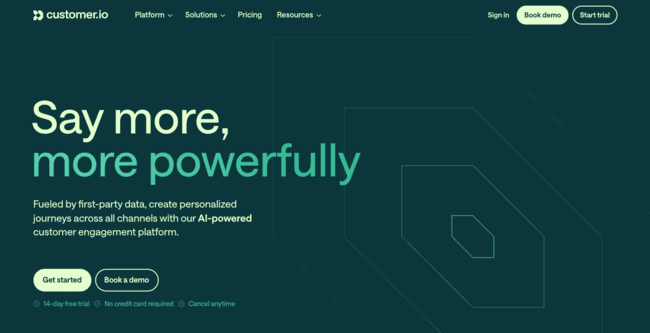
Customer.io ticks all the standard customer engagement platform boxes. It orchestrates and automates campaigns across different channels. It uses customer data to trigger and target. Like Braze, it’s great for event-driven, real-time messaging.
The main difference is scale and complexity. Customer.io is a simpler platform than Braze. It has fewer features. But they focus on the needs of smaller teams. For example, Customer.io covers fewer channels than Braze. Email, SMS, push and in-app notifications. And where Braze specializes in mobile. Customer.io puts more focus on email. It has a full user-friendly email editor for making pro-quality campaigns. And it supports very high sending volumes.
Customer.io also simplifies control over data. Braze relies on technical integrations between its data platform and external data sources. Customer.io has integrations with dozens of popular platforms. But it’s also developer-friendly. It has a long list of SDKs to support custom integrations. You can use data to define any custom attributes you want. Customer.io works on a system of custom objects for grouping customers initially. AI tools help you build segments within these groups. There are no limits on how detailed your segments can be. And they can adapt in real time.
From there, Customer.io functions like most standard marketing automation platforms. It has a user-friendly visual builder for building your workflows. You can mix channels and activate data with triggers and segments. As mentioned, it works particularly well for event-based triggers. This lets you automate responses in real time.
Customer.io Pros
- Provides Braze-like functionality with less complexity
- Built for real-time, event-based automation across channels
- Simplifies data integration and provides good support for developer-led teams
- Gives you full control over data attributes plus AI segmenting tools
- Strong on email, with a good email editor and support for high volumes
Customer.io Cons
- Covers fewer channels than many similar platforms.
- While Customer.io is simpler than Braze, many features still require technical know-how.
Pricing starts at $100 per month with 5,000 customer profiles. You can test it out on a 14-day free trial.
Send us a message if you’d like help finding the best Braze alternative for your business.
The Best Braze Alternatives by Company Size and Industry
If you’re a start-up, an SMB, or even a mid-market company. Braze can easily be overkill and out of your price range.
Many businesses would still love a platform that has functionality like Braze. Those looking for a Braze alternative that suits them tend to fall into the same few categories. Let’s break them down with the best tools for each group.
Braze Alternatives for Mid-Market SaaS
Mid-market SaaS teams want scale and sophistication from marketing automation. But they also want speed and agility. Many find Braze’s sheer size bogs them down. Yes, they want to improve customer engagement with targeted one-to-one messaging. But they also want speed and less of a technical load.
- ActiveCampaign is an outstanding marketing automation platform for small to mid-sized businesses. It connects sales and marketing workflows. And works for both B2B and B2C teams.
- Brevo is an all-in-one marketing and sales platform. It’s one of the most user-friendly tools around for multi-channel marketing automation. Mid-market teams can benefit from its automation, data platform, CRM, and loyalty products.
- Customer.io does all the main things Braze does. Just at a smaller scale with simpler implementation. And for a much lower price.
- MoEngage adds advanced analytics to campaign orchestration without the need for plug-ins. Rather than buying a single platform, you can choose the package you need.
- CleverTap’s Essentials tier includes the platform’s high-quality automation builder. And some of its advanced analytics options for building segments. Pricing is affordable, with plans starting at $75/month.
Braze Alternatives for Startups
Startups don’t need Braze’s advanced capabilities straightaway. And they certainly don’t need the price point. They need simple, affordable ways to find their groove engaging with customers. Learning who their customers are. And nurturing relationships accordingly.
- The HubSpot free CRM is an ideal starting point for new businesses. You can start to build a unified customer data source. Use insights to target email marketing campaigns. And track progress towards sales. HubSpot is also a great platform for growing with you.
- Brevo has one of the most generous free plans of any marketing automation platform. You can get started building event-triggered email campaigns for no cost. Pricing is affordable and grows in line with your customer database.
- ActiveCampaign has affordable starting prices for new businesses. And its campaign and automation tools are beginner-friendly while customizable enough to grow in complexity as your business develops.
- Omnisend is a great alternative for ecommerce startups. It integrates directly with Shopify. And makes it easy to feed Shopify customer data into targeted messaging. The free plan is great for getting started with email marketing and automation.
Braze Alternatives for Enterprise
Braze is by no means the only enterprise CEP out there. As the enterprise landscape is vast, from our overview the following would be marked as enterprise only.
- Insider One is a interesting Braze alternative for onsite personalization. It has a CDP with native integrations for 100+ platforms. And uses AI for personalized content management.
- Salesforce Agentforce Marketing’s biggest advantage is direct integration with Salesforce’s giant software ecosystem, including its CRM. It suits enterprises that want a full marketing and sales stack. Or for getting to grips with agentic AI.
- Iterable is a close Braze competitor. Trading Braze’s most advanced orchestration capabilities for ease of use. It has a a no-code data management tool that reduces reliance on dev teams.
- CleverTap shortens the path from data management to marketing activation. It has a built-in data warehouse that can capture 10,000 data points per customer every month. This fuels powerful behavioral analytics and event-based targeting.
Braze Alternatives for Small Businesses
Good customer engagement strategies benefit small businesses as much as enterprises. But SMBs don’t need advanced tools for large-scale orchestration. They need marketing automation tools that are simple to use and affordable.
- ActiveCampaign is a marketing automation platform for SMBs with one of the best automation builders. It uses 900+ templates and a visual no-code builder to simplify workflow creation. But it’s customizable enough to automate sophisticated journeys as businesses grow. It’s especially good for unifying sales and marketing with one tool.
- Brevo specializes in multichannel campaign building and automation for SMBs. It’s known for its ease of use and low cost. It also has products for transactional emails, CRM, and loyalty. So you can do a lot in one platform.
- HubSpot is an excellent all-in-one customer platform for SMBs. Its small business CRM bundle covers campaign building, marketing automation, sales pipelines, ecommerce, customer service, and data management tools. You can start for free with simpler versions of the same tools. And scale to more powerful tools as your business grows.
Braze Alternatives for Ecommerce
Braze lacks ecommerce-specific engagement options. Things like product recommendations, targeted discounts, and loyalty tools. But there are plenty of CEPs built specifically for online stores.
- Maestra is a powerful marketing platform for ecommerce businesses and DTC brands. It works via custom-built, managed integrations with any ecommerce platform. And uses customer data from your store for campaign automation and personalization. This covers email, SMS, on-site and in-app messaging, targeted promotions, loyalty and product recommendations.
- Omnisend is an excellent marketing platform for small to midsize online retailers. It works with Shopify, WooCommerce, and Magento. It simplifies campaign building and automation. And supports an impressive range of channels.
- Klaviyo is an email and SMS marketing platform for ecommerce brands that want data-driven messaging without enterprise complexity. It integrates directly with platforms like Shopify, BigCommerce, and Magento, and pulls in first-party store data to power segmentation and automation.
Braze Alternatives for In-App Messaging and SMS
Braze is known as a mobile-first CEP. But it doesn’t suit every business seeking mobile marketing orchestration.
- CleverTap has a great mobile channel mix. With unique extras like in-app inboxes and content optimization. Its biggest strengths are its powerful native data management and analytics features. And it’s great for A/B testing.
- MoEngage is a good mobile-first CEP for mid-market businesses. It’s easier to deploy than Braze. Its tools are more user-friendly. It’s cheaper, and breaks key features out into different products. So you only pay for what you need.
Contact us if you’d like help finding the best Braze alternative for your business.
Braze Cost Comparison with Alternatives
A lot of CEPs don’t publish pricing. Braze is one of them. It’s an issue with enterprise software in general. Platforms hide behind the ‘custom pricing is based on usage’ line. But that doesn’t stop you from giving an indication. It just means people are wasting their time requesting a quote if a platform is out of their price range.
So kudos to those who do publish pricing. Here’s a summary of those that do.
| Starting price per month | Active customers | User seats | Free plan/trial/demo | |
| Maestra | $2,990 | 150,000 | Unlimited | Demo |
| Omnisend | $11.20 | 500 | Unlimited | Free plan |
| HubSpot | $9 | 1,000 | 1 | Free plan |
| Klaviyo | $20 | 500 | 1 | Free plan |
| ActiveCampaign | $15 | 1,000 | 1 | 14-day free trial |
| CleverTap | $75 | 5,000 | Unlimited | 30-day free trial |
| Customer.io | $100 | 5,000 | Unlimited | 14-day free trial |
Braze pricing starts in the region of $60,000 a year. So that works out at $5,000 a month for unlimited user seats. Salesforce Agentforce Marketing, Iterable, and Insider One are in a similar price bracket. MoEngage is cheaper.
Contact us if you’d like a more comprehensive pricing overview and help with software selection.
What Are the Best Braze Alternatives?
Let’s wrap things up with the big question. What are the picks for the best Braze alternatives?
Size and type of business really matter in choosing the ideal Braze alternative. Braze is part of a pretty small category of CEPs built for enterprise brands. But there are plenty of other platforms that help optimize engagement strategies. They might go by different names to CEP. But they are great if you want to enhance user engagement nonetheless.
For SMB ecommerce stores, Omnisend is my go-to pick. It connects to Shopify and other major ecommerce platforms in minutes. And makes it easy to drive sales with abandoned cart automations, product recommendations, and email and SMS campaigns without Braze-level complexity or cost.
If you want an all-in-one CRM platform, HubSpot is hard to beat. You can start free, unify your customer data, and layer in email marketing and automation as you grow, without needing a heavy technical setup.
For SMBs, ActiveCampaign is my top choice. Its automation features are easy to use and very customizable. It’s affordable and grows with you. 900+ workflow templates simplify implementing very precise marketing strategies. And it suits so many types of business: B2C, B2B, ecommerce, and SaaS.
For larger ecommerce businesses, Maestra is a real powerhouse. It covers the unique digital marketing approaches that matter to online retailers: loyalty, coupons, and targeted product recommendations. But its superpower is personalization. And the way it pulls behavioral data from your web store into its own CDP and activates it through dynamic email content and on-page messaging.
Get custom software selection guidance from our experts to find the best Braze alternative for your business.
Braze Alternatives FAQ
What is Braze similar to?
Iterable, CleverTap, and Insider One are direct rivals. MoEngage and Customer.io have similar tools but target smaller mid-market businesses. Salesforce Agentforce Marketing, meanwhile, includes omnichannel messaging within a larger set of features.
All of these services specialize in real-time messaging orchestration across similar channels. They all cover email, SMS, in-app messaging, push notifications. And usually messaging apps like WhatsApp. The differences come in cost. Ease of use and implementation. And data architecture.
Is Braze a unicorn?
Is Braze like Klaviyo?
Braze is an enterprise CEP suitable for all types of business. It manages messaging orchestration and targeting throughout the customer lifecycle. And specializes in very high messaging volumes, especially on mobile. Braze is a powerful but complex platform. It requires a lot of technical support and integrations with other software to work best. Klaviyo is much more user-friendly and straightforward.
Is Braze better than Salesforce?
Braze is better at handling very large volume, complex messaging requirements. It has more specialized channel features, especially on mobile. And is better for optimized orchestration. Or picking the best way to reach a customer in real-time. Salesforce is better if you want to manage customer interactions as part of a larger omnichannel marketing package. And is an obvious choice if you already use other Salesforce products.