
Why Customer Identity is Moving to the Enterprise Data Layer

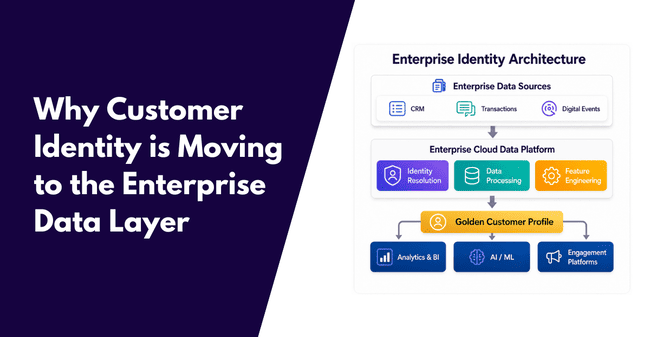
For years, customer identity resolution has been treated as a marketing problem. Brands stitch together fragmented customer data with their CDPs, ESPs, and adjacent marketing technology. All to create a (unified) customer view for marketing activation.
That works for immediate campaign execution, but it never addressed the enterprise challenge. The data is still scattered across multiple systems, resulting in multiple versions of customer identity, each with different logic, rules, and data inputs.
This data fragmentation was tolerated. Mainly because marketing systems operate in isolation. But organizations now pursue omnichannel orchestration, AI-driven decisioning, advanced analytics, and enterprise-wide personalization. Fragmented identity models become a structural limitation.
Today, enterprises need to rethink the “stitch it” approach.
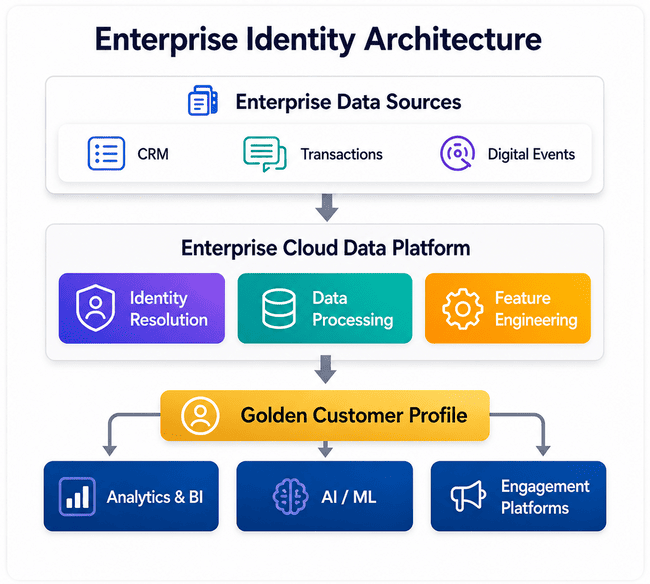
Modern enterprise data platforms like Databricks and Snowflake now provide the scale, flexibility, and governance controls to centralize identity resolution in the enterprise data layer itself.
In this model, identity moves out of separate marketing platforms and becomes an enterprise-owned capability. Available not only to marketing, but to analytics, service, fraud, operations, and machine learning teams across the organization.
This shift fundamentally changes the role of modern engagement platforms and ESPs.
Rather than serving as both the system of record for identity and the system of execution, ESPs and engagement platforms function as execution and orchestration layers. The unified profiles are in the enterprise data platform, and the platforms focus on communication, journey management, and customer interaction.
The Problem with Traditional Customer Identity Models
Many organizations today maintain three, four, or even five different versions of “the customer,” each in a separate platform and governed by different rules. The results are predictable: fragmented customer identity across the enterprise.
In our consulting work, this fragmentation has become one of the most common architectural issues we see for enterprise brands modernizing their martech stack.
This identity fragmentation creates business and operational challenges:
- inconsistent customer records across systems
- duplicate or conflicting identity logic across teams
- increased governance and compliance complexity
- difficulty auditing data lineage and match rules
- higher operational costs from duplicated data processing
- limited ability to use identity for non-marketing use cases
While the old model may have been manageable in a batch-oriented, channel-centric marketing environment, it becomes increasingly problematic in a world where organizations seek to recognize and act on customer behavior in real time.
In one recent enterprise RFP, a brand mapped out a simple use case:
A customer browses a product, abandons, and receives a follow-up message within minutes. Sounds basic. But when we walked through the architecture, the reality looked very different:
- Event captured in one system
- Batched into a warehouse
- Synced into a CDP
- Rebuilt into an audience
- Then pushed into the ESP
By the time the message was eligible to send, the moment had passed. That’s when it clicked for the client: this wasn’t a use case problem, it was an architecture problem.
In most enterprise environments we review, 60–80% of available behavioral signals are either delayed, unused, or never activated at all. Not because they lack value, but because the architecture can’t support acting on them in time.
Why this model is breaking down
The shortcomings of fragmented identity architecture become apparent as enterprise expectations grow. Modern organizations expect customer data to support:
- omnichannel orchestration
- AI and predictive modeling
- enterprise analytics
- real-time personalization
- service and support use cases
- fraud and risk analysis
Identity can’t be viewed as a marketing-only asset anymore. A fragmented identity model limits the organization’s ability to create consistent decision-making across departments and introduces latency and complexity into every downstream process. The rise of modern cloud data platforms has created a compelling alternative: enterprises with scalable environments that house and process vast volumes of customer data while supporting sophisticated matching, governance, and machine learning workflows.
As a result, organizations ask a simple but important question:
If the enterprise data platform already houses the customer data, analytics models, and machine learning environment, why should identity resolution live anywhere else?
The Emergence of the Enterprise Data Layer as the Identity Hub
Increasingly, the answer is: it shouldn’t.
Leading organizations are moving identity resolution into the enterprise data platform and treating the unified customer profile as an enterprise asset rather than an application-specific construct.
In this model:
- The enterprise data platform becomes the system of record for identity
- Identity resolution logic is managed centrally
- Unified profiles are distributed downstream to consuming systems
- Engagement platforms consume identity rather than create it
This architecture offers several advantages:
1. Enterprise Utility
A centralized identity graph can support:
- marketing
- analytics
- customer service
- fraud detection
- machine learning
- operational reporting
2. Governance and Consistency
Organizations gain:
- centralized control over identity rules
- improved auditability and lineage
- stronger enterprise governance
3. Reduced Duplication
Rather than maintaining multiple overlapping identity systems, the enterprise maintains one identity model for all functions. This architecture is particularly well-suited for:
- Large enterprises with mature data engineering resources
- Organizations already invested in Databricks, Snowflake, or modern cloud data warehouses
- Businesses requiring identity across multiple enterprise functions
- Brands prioritizing governance, flexibility, and scalability
However, this model isn’t ideal for every organization. Companies with limited data engineering resources, simple engagement requirements, or less mature technology stacks still benefit from email marketing platforms with embedded identity models.
How Identity Resolution Works in a Data Platform-Centric Architecture
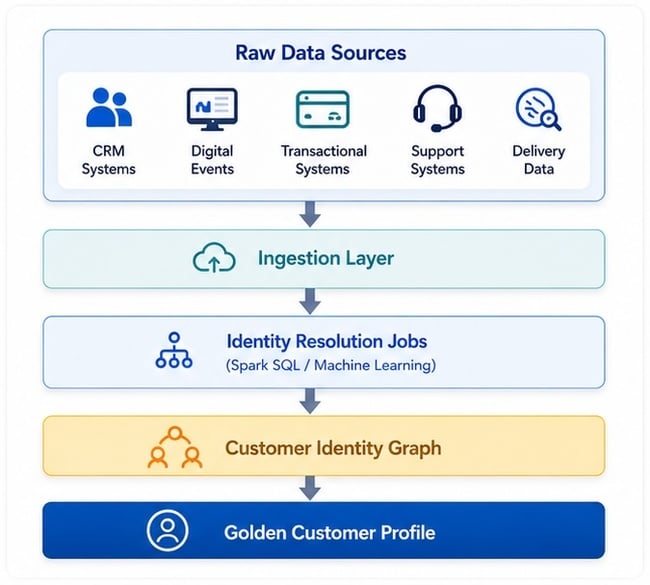
Centralizing identity in the enterprise data layer doesn’t eliminate the need for identity resolution. It simply changes where and how it’s done. The marketing platforms don’t stitch together the records internally, but organizations build identity resolution pipelines directly to the enterprise data platform using deterministic and probabilistic matching logic.
A typical identity framework has two forms of matching:
Deterministic Matching
Deterministic matching uses exact identifiers to link records, including:
- email address
- phone number
- CRM/customer ID
- login credentials
- loyalty/member ID
This method has high confidence and is typically used as the foundation of identity resolution.
Probabilistic Matching
Probabilistic matching adds to deterministic matching by identifying likely relationships between records using signals such as:
- name similarity
- mailing address similarity
- device relationships
- behavioral patterns
- purchase history
These models assign confidence scores to determine whether records should be merged into the same identity.
When combined, these techniques let organizations build a far more sophisticated and flexible identity framework than embedded marketing platform identity tools normally have.
From Customer Record to Identity Graph
Modern enterprise identity systems no longer rely on a single static “customer record.” Instead, they use an identity graph. A dynamic framework that connects all known identifiers associated with an individual, household, or account.
An identity graph allows organizations to:
- maintain relationships between multiple identifiers
- track identity evolution over time
- support household and buying-group structures
- preserve historical lineage across merged records
With every identity resolution, the enterprise data platform can generate:
- a Golden Customer Profile
- a Golden Account Profile
- or other profile structures that fit the business model
These profiles then become the enterprise-wide source of truth consumed by downstream systems.
Redefining the Role of the ESP/Engagement Platform
When identity resolution moves into the enterprise data layer, the purpose of the engagement platform changes. Many ESPs and CDPs attempted to serve as:
- the repository of customer identity
- the engine for campaign execution
Increasingly, organizations are separating those responsibilities. In a modern architecture:
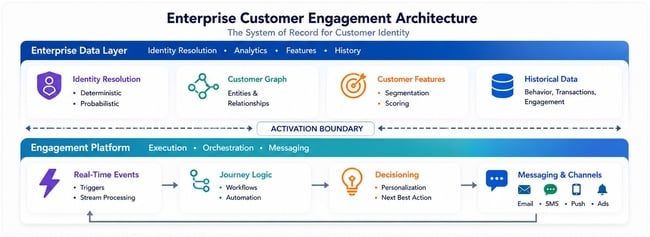
- The enterprise data platform manages identity, analytics, and intelligence
- The engagement platform manages orchestration, decisioning, and execution
This separation creates a cleaner and more scalable architecture. It also allows organizations to evaluate engagement platforms based on what they are intended to do: execute customer engagement. Rather than over-indexing on identity resolution, brands can focus platform selection around:
- real-time event processing
- journey orchestration
- decisioning sophistication
- channel support
- experimentation tools
- governance and controls
Now the engagement platform becomes an execution engine operating on top of enterprise-owned intelligence.
Architectural Implications for Platform Selection
This shift changes how organizations evaluate engagement and marketing automation platforms. For years, vendors positioned embedded identity resolution as a major platform differentiator.
However, that value proposition is eroding. If identity is managed upstream in the enterprise data layer, the value of embedded identity functionality whittles down close to zero.
Organizations then prioritize:
Execution
- How quickly can the platform ingest signals?
- How quickly can it act?
- Can it process real-time triggers without latency?
Orchestration
- Can the platform manage complex journeys?
- Can it support omnichannel engagement?
Decisioning
- Does the platform support embedded rules and AI-driven next best action?
Governance
- Does the platform provide enterprise-grade controls and approval processes?
As identity becomes centralized elsewhere, execution architecture increasingly becomes the true differentiator between modern engagement platforms.
Customer identity is an enterprise asset
The role of customer identity within the martech stack is evolving. As enterprises mature their data infrastructure and invest in modern cloud platforms like Databricks and Snowflake, customer identity is increasingly moving out of individual applications and into the enterprise data layer. This shift reflects a broader realization:
Customer identity is not only a marketing asset, it’s also an enterprise asset.
By centralizing identity resolution within the data platform, organizations can improve governance, reduce duplication, and enable broader enterprise use of unified customer intelligence.
At the same time, this architecture allows email service providers to focus on what they do best: orchestrating and executing customer interactions. The future of customer engagement architecture won’t be defined by monolithic platforms attempting to do everything. It will be defined by specialized systems operating within a coordinated ecosystem. Where the enterprise data platform owns identity and intelligence, and the ESP owns orchestration and execution.
Organizations that embrace this model will be better positioned to support the next generation of personalization, analytics, AI, and customer engagement.